It was supposed to be one of those perfect days.
The kind that makes you feel like maybe you are healing: Sun on your face, breeze in your hair, the trail crunching under your boots. You remember smiling. Maybe laughing. Breathing in deeply, like your lungs were part of the landscape.
Your body finally felt like yours again, for a minute.
But something else was along for the hike.
A few weeks later, you were spiraling. First came the weird headaches. Then the fatigue. Not tiredness, bone-deep depletion.
You started forgetting words mid-sentence. Joints ached in places you didn’t even know had joints.
Maybe your vision got blurry. Maybe you told your doctor, and they ran some labs and said, “Everything looks fine.”
You probably wanted to punch a wall, but didn’t have the energy.
Whether you got the “official” Lyme diagnosis or are still stuck in the maybe-this-is-anxiety twilight zone, one thing is clear: your body hasn’t been the same since.
Let’s talk about a tool that’s helping more people with persistent Lyme symptoms than most doctors realize: Hyperbaric Oxygen Therapy (HBOT).
It’s not hype, it’s not woo-woo, and it’s not going to solve everything.
But for people dealing with post-Lyme fatigue, brain fog, and those stubborn, lingering symptoms that make you feel like a ghost of your old self, it might just be the oxygen you’ve been gasping for.
Let’s break it down.
Key Takeaways
- Lyme isn’t just a tick bite. It’s a biological war.
- HBOT restores your body’s natural healing intelligence.
- m/HBOT is a safer, smarter choice for sensitive systems.
What Is HBOT (and m/HBOT)?
If you’re anything like me, you want to know how this works before you spend another cent or second chasing solutions.
HBOT stands for Hyperbaric Oxygen Therapy. It’s a non-invasive therapy where you breathe 100% oxygen in a pressurized chamber, typically 1.5 to 2.5 times the normal atmospheric pressure (called ATA) (8, 13, 15, 16, 18, 23, 28, 29, 35).
That pressure forces more oxygen into your bloodstream, and not just into your red blood cells: Into your plasma (8, 12, 13, 26, 28, 33), which means your tissues and organs get access to way more oxygen than they normally would.
In chronic conditions like Lyme, many of your tissues (including your brain) are oxygen-starved. That’s why HBOT can feel like flipping the breaker back on in places that haven’t had power in a while.
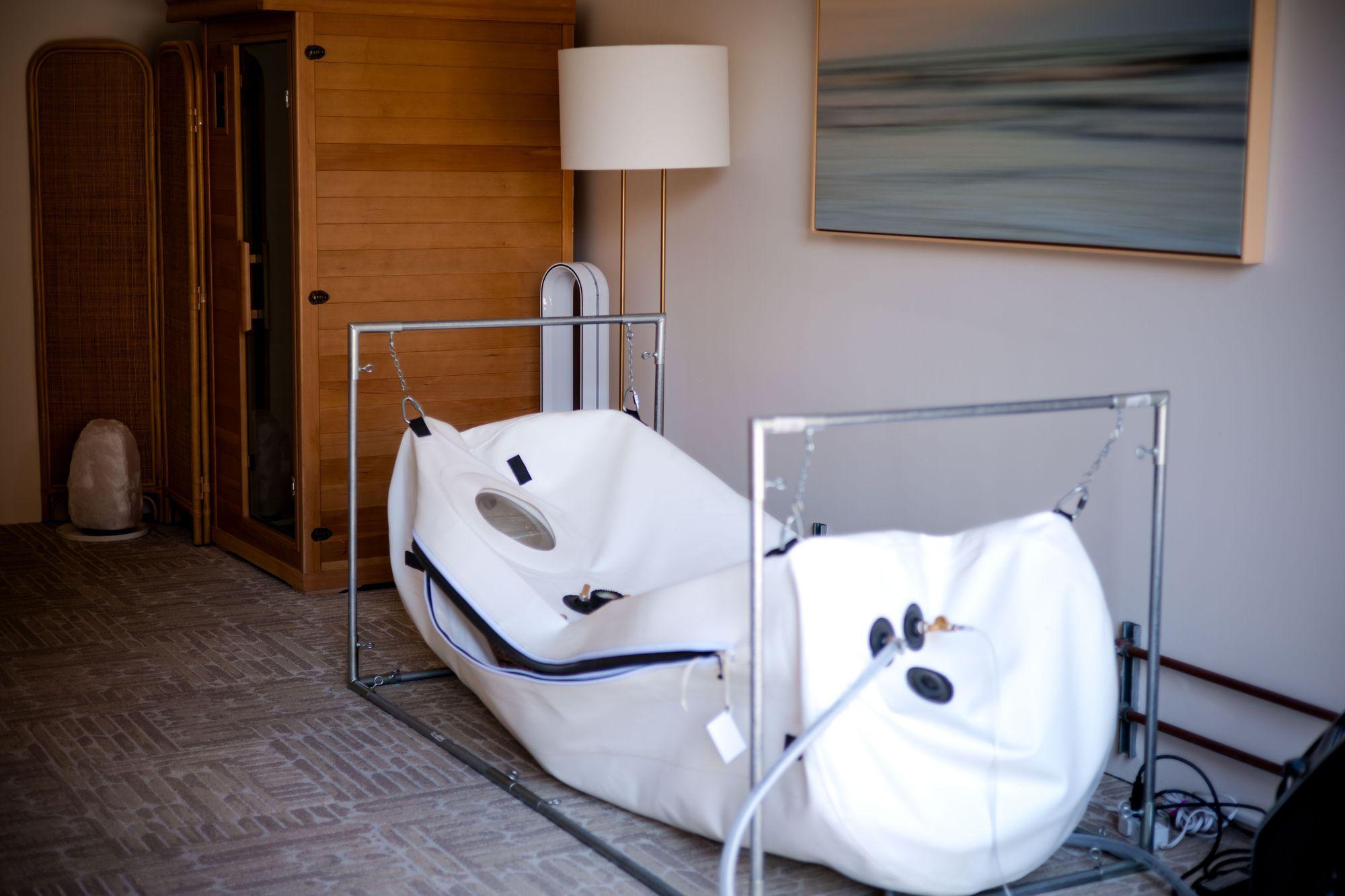
There’s also a gentler version called mild hyperbaric oxygen therapy, or m/HBOT (we use both at the Selah Center).
(I use HBOT to indicate both HBOT and m/HBOT.)
These chambers usually run at lower pressure (around 1.3 ATA) and sometimes use ambient air instead of 100% oxygen.
Both versions increase the amount of oxygen your body has to work with.
And when you’re dealing with fatigue, inflammation, neuro symptoms, or sluggish detox, that extra oxygen can mean the difference between surviving and healing.
Now, HBOT isn’t some fringe idea. It’s been used for things like:
- Non-healing wounds (3, 5, 11, 12, 19, 24, 25, 28)
- Carbon monoxide poisoning (1, 19, 20)
- Gas gangrene (yep, that’s a real thing) (8, 12, 19, 28)
- Decompression sickness (1, 19, 28)
- Traumatic Brain Injury (1, 12, 17, 35, 36)
- Certain forms of hearing loss (4, 19)
- Burns (35)
- PTSD (10, 36)
- Neurodegenerative diseases (1, 21)
It’s also being studied for conditions like anxiety, chronic fatigue, mold exposure, and yes persistent Lyme symptoms.
If your nervous system has been running on fumes, if your immune system feels like it’s stuck in mud, and your brain is a barely functioning dial-up modem, m/HBOT could be the spark your cells have been waiting for.
What Is Lyme Disease?
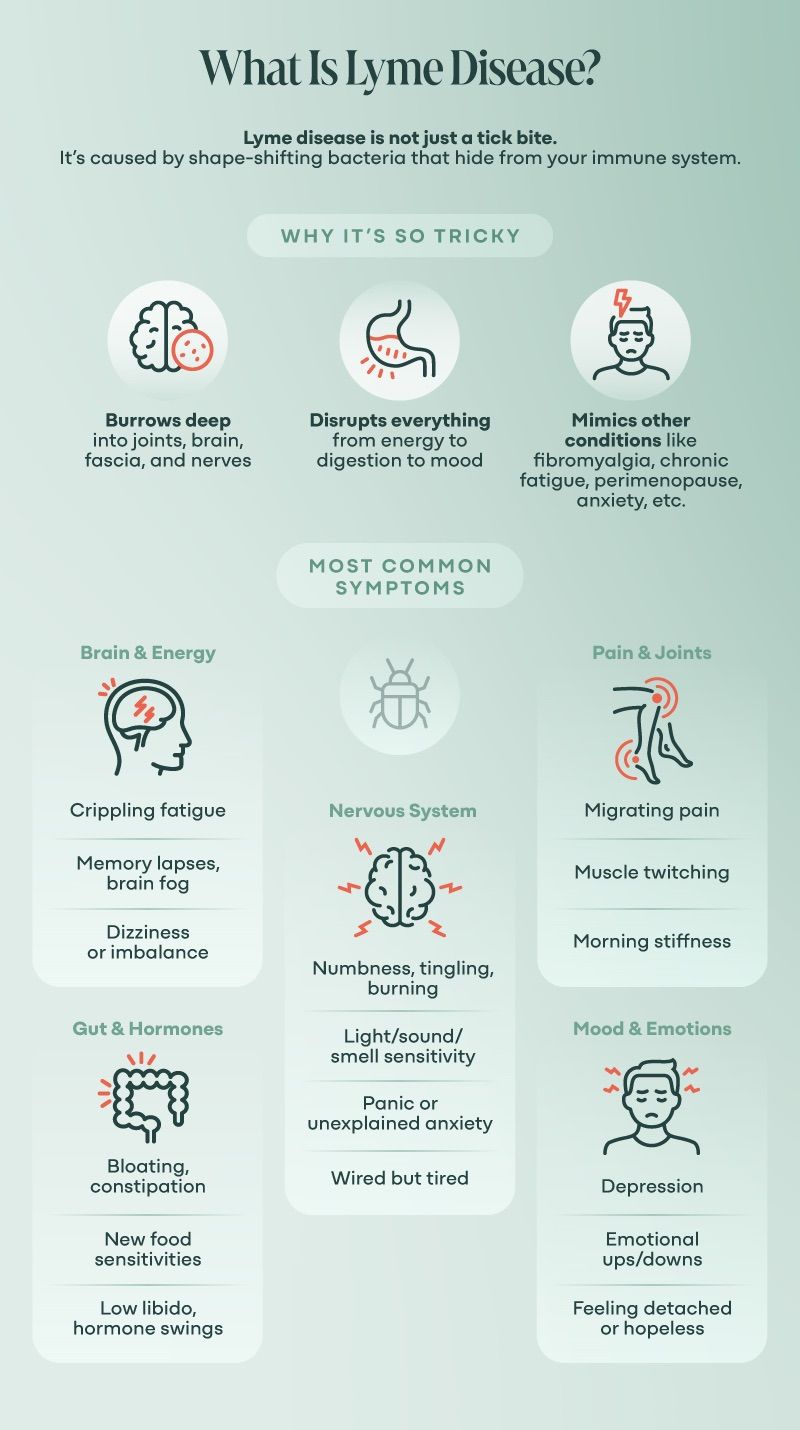
At its core, Lyme disease is a stealth infection caused primarily by the bacterium Borrelia burgdorferi, often transmitted through the bite of a tick (39-50).
Borrelia is a shape-shifter, literally. It can morph into different forms to evade your immune system, slip past antibiotics, and burrow into tissues like your joints, fascia, nervous system, and brain. It builds biofilms (think: protective slime bunkers) and hides inside your cells, where your body can’t easily detect or destroy it (42). And it rarely travels alone.
Most people dealing with persistent symptoms aren’t just fighting Borrelia. They’re also carrying co-infections like (39-50):
- Babesia (a malaria-like parasite that affects red blood cells)
- Bartonella (linked to neuro and vascular symptoms)
- Ehrlichia and Anaplasma (white blood cell disruptors)
- Mycoplasma, Rickettsia, and more
Like all pathogens, they cripple your mitochondria, wreck your immune tolerance, dysregulate your nervous system, and flip your terrain into a survival state that’s hard to unwind (51, 52, 53). That’s why people with Lyme often feel like they’ve aged 30 years in six months. It’s not “just a tick bite.”
And unless your doctor understands all that (biofilms, terrain theory, and the role of co-infections) they’ll likely miss it. Or worse, they’ll tell you it’s in your head.
(Hint: it’s not in your head. It’s in your cells. And it’s fixable.)
Symptoms of Lyme Disease
Lyme rarely shows up the same way twice. This is why it’s sometimes called “the great mimicker.”
Some people get the classic flu-like symptoms and joint pain early on. Others don’t feel anything until months (or even years) later, when their health starts falling apart for “no reason.” That’s because Lyme is a multi-system disruptor.
It doesn’t stay in one place. It moves through your body, stirs up inflammation, and kicks off a chain reaction that can leave you feeling like a stranger in your own skin.
Here are some of the most common symptoms as well as the ones that tend to stick around long after the initial infection (39, 40, 43, 44, 45, 46, 47):
Energy and Cognition
- Crippling fatigue that sleep doesn’t fix
- Brain fog so thick you forget what day it is
- Memory glitches and slowed thinking
- Dizziness or “off” balance sensations
Nervous System
- Numbness, tingling, or burning in hands and feet
- Sensitivity to light, sound, smell, or even touch
- Panic attacks or unexplained anxiety
- Insomnia, or feeling wired-but-exhausted
Pain, Muscles, and Joints
- Migrating joint pain (hips one day, knees the next)
- Muscle twitching or spasms
- Stiff neck, especially first thing in the morning
Digestion and Hormones
- Bloating, constipation, or unpredictable digestion
- Food sensitivities that seem to grow over time
- Irregular cycles, low libido, thyroid weirdness
Mood and Emotion
- Depression (even when life is “fine”)
- Emotional swings that don’t make sense
- Feeling detached, hopeless, or like your spark is gone
Sound familiar? Because these symptoms can shift and overlap, you may have been told it’s fibromyalgia, chronic fatigue syndrome, anxiety, perimenopause, or just “stress.” But deep down, you know something’s been off since that moment in nature.

What About ‘Chronic Lyme?’
Ahhh yes, the phrase that makes some doctors squirm: “chronic Lyme.”
If you’ve ever mentioned it in a doctor’s office, you might’ve gotten “The Look.” The one that says, “Here we go, another internet diagnosis.”
But whatever label you’ve been given (or denied), the symptoms you’re dealing with are real, and they didn’t vanish after 21 days of doxycycline.
You’re still tired and inflamed, still cycling through waves of pain, brain fog, and a body that doesn’t feel like home.
This is what many call chronic Lyme, persistent Lyme, or post-treatment Lyme (40, 41, 48, 49, 50).
So why do symptoms hang on?
The Bugs Are Still There (Just Hiding)
Borrelia burgdorferi is a master of disguise. It may:
- Morph into “cyst” and “L-forms” that resist antibiotics (this is still being debated)
- Hide inside biofilms (slimy microbial shields) (42)
- Camp out in low-oxygen tissues like joints, brain, fascia, and gut (39, 40)
You’ve Got a Whole Party of Co-Infections
Babesia, Bartonella, Mycoplasma, and friends.
They all have their own tricks, and they don’t always respond to the same treatment.
Your Terrain Is Still Stuck in Survival Mode
Even if the microbes are mostly cleared, the damage they caused often lingers:
- Mitochondria are tanked
- Detox pathways are jammed
- Nervous system is dysregulated
- Hormones are swinging like vines in the jungle
And if you’ve got mold exposure, heavy metals, or chemical sensitivities on top of Lyme, that’s like trying to clean your house during a fire drill.
It’s time to recognize that your body is doing exactly what it needs to do to survive, but it hasn’t had the tools or conditions to heal.
That’s where therapies like m/HBOT come in. Not to replace your body’s wisdom, but to support it.
How HBOT Supports Healing from Chronic Lyme
If Lyme and its co-infections are commandeering your immune system, wrecking your mitochondria, and turning your nervous system into a stress response factory, what does oxygen have to do with fixing any of that?
Turns out: everything.
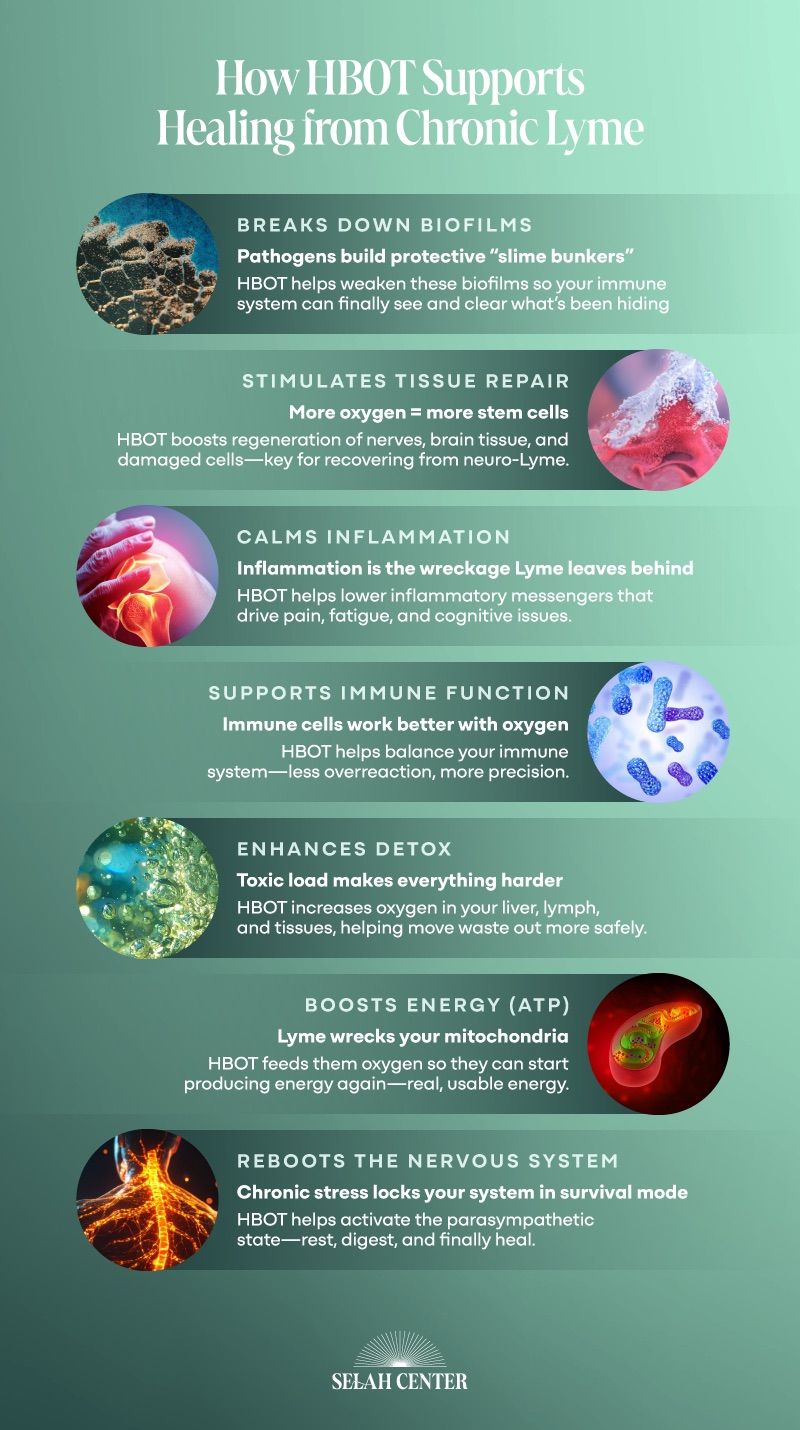
m/HBOT works not by “killing bugs,” but by setting the stage for your body to remember how to heal.
And if your terrain has been inflamed, oxygen-starved, and trapped in emergency mode for months (or years), then breathing pure oxygen under pressure might be exactly the signal your body needs to shift out of survival.
Here’s how it helps:
Deep Oxygen Delivery to Hypoxic Tissues
Lyme and co-infections love to hide in areas with poor blood flow, like your joints, brain, fascia, and GI tract.
HBOT increases the amount of oxygen dissolved in your plasma (8, 12, 13, 26, 28, 33), not just carried by red blood cells.
That means more oxygen gets into places your body hasn’t been able to reach in a long time.
Breaks Down Biofilms
Remember those microbial bunkers that protect pathogens from your immune system?
HBOT helps disrupt biofilms, making it easier for your immune cells (or targeted therapies) to finally see what they’re dealing with (54, 55).
This doesn’t mean HBOT replaces antimicrobial protocols, it means it can make them more effective.
Stimulates Stem Cell Production & Tissue Repair
Research shows that HBOT increases stem cell release and activation, which can help regenerate damaged tissue, including nerve and brain tissue affected by neuro-Lyme (8, 13, 14, 15, 16, 34).
If you’re dealing with word loss, facial tingling, or your nervous system feeling like it’s been through a blender, this is a big deal.
Reduces Inflammation at the Cellular Level
Chronic Lyme symptoms aren’t just from the bugs; they’re from the inflammatory wreckage left behind.
HBOT helps regulate inflammatory messengers like TNF-alpha, IL-1, and IL-6, which are usually sky-high in people with long-term Lyme (2, 8, 9, 13, 18, 19, 23, 25, 29, 35).
Less inflammation means less pain, better cognition, and more resilience.
Supports Immune Modulation
HBOT improves the function of immune cells like macrophages and neutrophils (12, 13, 19), while also calming overactive inflammatory responses.
If your immune system has been confused (attacking the wrong things or doing nothing at all) HBOT helps bring it back online.
Enhances Antioxidant Activity
HBOT increases the expression of superoxide dismutase (SOD) and other antioxidant enzymes (8, 12, 13, 19, 29, 35).
Why does that matter?
Because these enzymes protect your mitochondria from damage, and Lyme pathogens love to fry your mitochondria.
More antioxidants means less oxidative stress (1, 8, 12, 13, 14, 18, 28, 34, 35) and better energy.
HBOT isn’t about “beating” Lyme.
It’s about giving your body a breakthrough moment.
A chance to shift from defense into repair.
And when you’re this depleted, sometimes that oxygen boost is the first time your system has felt safe enough to do the real work of healing.
Can HBOT Help With Fatigue?
Let’s talk about the one symptom that makes everything else harder: Fatigue.
The “I can’t remember what it feels like to wake up with energy” kind.
The “I need to rest in the middle of a shower” kind.
If that’s your reality, you’re likely dealing with a cascade of physiological breakdowns, and chronic Lyme is just one part of that picture.
Here’s what’s usually driving that soul-sucking exhaustion:
Mitochondrial Dysfunction
Lyme, co-infections, and their inflammatory byproducts can wreck your mitochondria, the tiny engines in your cells that make energy (ATP).
Think of it like this: You’ve got the gas pedal down, but your fuel tank is cracked and leaking.
HBOT helps by supercharging your oxygen supply, which is one of the primary fuels your mitochondria need to make energy (1, 8, 15, 16, 35).
When oxygen delivery improves, so does ATP production. That means less dragging, more doing.
Hypoxia (Low Oxygen in Tissues)
When inflammation clogs up your microcirculation (those tiny capillaries that bring oxygen to your tissues), you end up in a state of silent suffocation.
Your organs might look “fine” on paper, but they’re gasping under the surface.
HBOT improves microcirculation and floods your system with oxygen-rich plasma, even in areas where normal circulation can’t reach (1, 8, 12, 14, 15, 33, 34). That’s why some people report clearer thinking, deeper sleep, and more physical stamina after just a few sessions.
Blocked Drainage and Toxic Burden
If your lymph, liver, and bowels aren’t moving toxins out, your body starts recycling trash, and your mitochondria pay the price.
This is especially true if mold, parasites, heavy metals, or chemical exposure are in the mix.
HBOT helps support detox indirectly by improving tissue oxygenation and reducing oxidative stress (1, 8, 12, 13, 14, 18, 28, 34, 35).
But this only works if your drainage pathways are already open. Otherwise, you’re just stirring the pot without clearing the junk.
Nervous System Dysregulation
If your system has been stuck in fight-or-flight for months (or years), it doesn’t feel safe enough to heal, let alone create energy.
HBOT has been shown to improve vagus nerve tone and support parasympathetic activation (19). That sweet, healing state where digestion works, sleep deepens, and inflammation cools down. And when your body stops running from tigers (real or metaphorical), it finally has the bandwidth to repair.
m/HBOT is a terrain tool. One that can shift your biology out of depletion and into recovery.
You won’t wake up like a superhero after one session. But when layered in at the right time, it can help you build real, sustainable energy from the inside out.
Who Should (and Shouldn’t) Consider m/HBOT?
By now, you might be wondering “Is this something I should try?”
And the answer is: Maybe.
(Helpful, I know. But stay with me.)
Like any healing tool, m/HBOT works best when it’s the right tool at the right time for the right terrain.
Let’s break it down:
You’re a Good Candidate for m/HBOT if:
- You’ve been treated for Lyme (or suspect you’ve had it for years), but still deal with crushing fatigue, brain fog, or nerve pain.
- You’ve cleared (or are actively addressing) mold, heavy metals, and co-infections, and now you’re working on repair.
- You’re dealing with neuro-Lyme symptoms, like forgetfulness, mood shifts, or sensory sensitivity.
- You’ve plateaued in your healing, and your body needs a nudge to shift out of freeze mode.
- You’ve already done some nervous system regulation work, enough to know how to ground yourself if a big shift happens.
- You’re supporting drainage pathways (liver, lymph, colon) consistently so if your body stirs up debris, it can get out.
You May Need to Wait or Work up to it if:
- You have severe mast cell activation, histamine intolerance, or are extremely sensitive to any new input (even “gentle” supplements).
- You’re not pooping daily (Sorry, not sorry. This matters).
- You still live or work in a moldy environment (oxygen won’t fix a toxic fishbowl).
- You’re feeling fragile, panicked, or hyper-reactive most days. HBOT might be too stimulating if your nervous system is in overdrive.
- You’ve never done any drainage prep, and your body’s detox pathways are more of a traffic jam than a freeway.
m/HBOT is a builder, not a bypass. If your terrain is overloaded, it can stir up too much too fast.
And nobody needs another crash disguised as “healing.”
m/HBOT vs. HBOT: What’s the difference?
m/HBOT (mild hyperbaric oxygen therapy):
- Around 1.3 ATA (lower pressure), often with ambient air
- Gentler on the system
- Great for people easing into recovery or with high sensitivity
HBOT (clinical hyperbaric oxygen therapy):
- 1.5–2.5 ATA with 100% oxygen
- More potent and research-backed for neuro recovery
- Best when you’re ready for deeper repair and have the foundation in place

A Comment on the Research
It’s important to note that most of the research on HBOT has been done using hard-sided chambers, the kind found in hospitals, integrative clinics and research institutions, typically running at higher pressures (2.0+ ATA) with 100% oxygen.
Why? Because that’s where the funding goes.
Large institutions and medical device manufacturers are more likely to invest in studies when there’s a billable code, a patented device, or a reimbursable outcome at the end.
That doesn’t mean m/HBOT isn’t effective, it just means the research is playing catch-up.
Anecdotally and clinically, thousands of patients with chronic conditions, including persistent Lyme, report significant benefits from mild chambers, even at lower pressures.
At The Selah Center, we offer both HBOT and m/HBOT, because there’s a time and place for each.
Healing isn’t one-size-fits-all, and neither is oxygen therapy. We often begin with m/HBOT (mild hyperbaric oxygen therapy) because it’s gentler on the system.
Many of our clients are navigating nervous system dysregulation, toxic injury, mast cell reactivity, or post-infection fatigue. For these sensitive bodies, more pressure isn’t always better, and sometimes it can even backfire.
m/HBOT offers a more tolerable and sustainable path, allowing oxygen therapy to support repair without overwhelming the system.
But when the terrain is ready (drainage is open, resilience is up, and mitochondrial repair is underway), we may introduce higher-pressure HBOT for deeper tissue oxygenation and accelerated recovery.
That’s the beauty of a terrain-based approach: we match the therapy to your biology, not the other way around.
The Big Picture: Healing Terrain First, Oxygen Second
You can’t oxygenate your way out of a blocked system.
If your detox organs are still overwhelmed, if your nervous system still thinks it’s running from a tiger, if your body is still full of mold, metals, or mystery exposures, then all that beautiful oxygen might stir the pot instead of supporting your healing.
That doesn’t mean m/HBOT isn’t worth it; it just means you need a comprehensive approach to healing.
What Does ‘Prepare the Terrain’ Look Like?
- Supporting drainage pathways (yep, we’re talking bowels, liver, lymph. Allll the glamorous stuff)
- Addressing co-infections, toxins, and stealth bugs as needed
- Regulating your nervous system so your body knows it’s safe to rest and repair
- Rebuilding mitochondrial health with real nourishment and pacing
- Reframing symptoms as messages, not mistakes
When your body finally has the oxygen, resources, and safety to shift gears, that’s when real healing starts to spiral upward, and you stop feeling like your symptoms are running the show.
So Where Does m/HBOT Fit In?
It’s not the first step, but it can be a beautiful accelerator once you’ve laid the foundation.
Think of it like this:
- Drainage = the plumbing
- Nervous system regulation = the circuit board
- m/HBOT = the power surge that turns the lights back on
And when those lights come on, that’s when your body starts to feel like yours again.
Your Next Step Toward Energy & Clarity
For many people (especially those navigating post-treatment symptoms, brain fog, or deep mitochondrial exhaustion) oxygen therapy becomes a turning point, because it can create the internal conditions your body needs to finally move forward again.
Your body hasn’t given up on you, not even close.
Let’s support it with oxygen, with strategy, and with care, and let’s take that next aligned step, together.
FAQs
1. Can HBOT kill Lyme bacteria?
Not directly. HBOT isn’t an antimicrobial in the classic sense. It creates conditions that disrupt pathogen hiding places, support immune clarity, and enhance the effectiveness of other therapies.
2. What’s the difference between HBOT and mHBOT?
HBOT uses higher pressure (1.5–2.5 ATA) and 100% oxygen, typically in hard-sided chambers. m/HBOT is gentler (1.3 ATA, ambient or enriched oxygen), often better tolerated by sensitive systems. Both increase oxygen levels; the right one depends on your terrain.
3. How soon will I feel better?
Some feel shifts in brain fog or energy after just a few sessions. For others, it takes 20–40 sessions to notice deep improvements.
4. Will I herx from m/HBOT?
It’s possible, especially if your drainage and detox systems are clogged. That’s why we prep the terrain first, so you detox with your body, not against it.
5. What if I’m super sensitive to treatments?
That’s exactly why we offer m/HBOT at The Selah Center. It’s better tolerated by clients with mast cell issues, chemical sensitivities, or a history of crashing from “too much too fast.”
6. Will m/HBOT help with brain fog?
It can and often does. m/HBOT increases oxygen in your brain tissue and stimulates stem cell activity, which supports nerve repair, memory, and mental clarity.
7. Can I do m/HBOT while treating co-infections or mold?
Yes, if your drainage is open and your system is ready. m/HBOT pairs well with other protocols but should be layered in strategically to avoid overwhelm.
8. Do I need to do anything to prepare for m/HBOT?
Yes, ideally, you’ve already started drainage support, nervous system work, and reduced exposure to mold or toxins. m/HBOT works best when your body knows it’s safe to heal.
9. Are there contraindications for m/HBOT?
m/HBOT may not be suitable for individuals with untreated pneumothorax, certain lung conditions, or active sinus or ear infections. Caution is also required for those with seizure disorders or a history of claustrophobia. We carefully screen each client to ensure safety, bioindividuality, and best outcomes.
This article is for general education and is not a substitute for personal medical advice.