You know that feeling when your brain is playing a horror movie marathon, but you’re the star, and it’s 3AM?
Maybe it’s the spiraling thoughts you can’t turn off. Or the flatline fatigue that coffee won’t touch. Or the edge-of-panic feeling that shows up for no reason while you’re just trying to buy cucumbers.
You’re not “just anxious.” And you don’t need another prescription to prove it.
Chances are you’ve already been dismissed by someone with a white coat and a 7-minute attention span.
Maybe you’ve done the gut protocols, the Vagus nerve resets, the $1,400 supplement stack you saw on Instagram.
And yet, your nervous system still feels like it’s stuck in a loop. Burned out but wired. Foggy but overstimulated. Tired but can’t sleep. Sound familiar?
That’s where brain retraining comes in.
Maybe someone mentioned neurofeedback.
Maybe your chiropractor whispered something about “IASIS” and then looked at you like they had just handed you the holy grail.
And now you’re here, trying to figure out what the heck the difference is.\
I’ve got you. We’re going to break it all down: What IASIS is, how traditional neurofeedback works, what kind of person benefits from each (and who doesn’t), and how to choose what’s right for your brain, your body, and your long-haul healing goals.
Because you can’t keep muscling through chronic symptoms with a fried nervous system. And you don’t have to.
Key Takeaways:
- IASIS offers a passive reset, not a mental workout.
- Traditional neurofeedback requires focus, stamina, and structure.
- The therapy you choose should match your brain’s current capacity.
What Is IASIS Microcurrent Neurofeedback?
IASIS (pronounced eye-uh-sis) Microcurrent Neurofeedback is a gentle, non-invasive tool that helps your brain break out of dysfunctional patterns by giving it the tiniest of nudges.
We’re talking picowatt electromagnetic signals so subtle, you won’t feel a thing.
But your brain will.
Think of it like this: your brain is behaving like an old-fashioned record player stuck in a skip. Same thought loops. Same stress response. Same freeze, fatigue, fog.
IASIS doesn’t train your brain to do anything. It simply interrupts the loop so your brain can reset and find a more functional rhythm again.
What Happens in a Session?
You sit in a comfy chair, a few small sensors are placed on your scalp and neck, and you chill while the system runs for about 20–30 minutes.
You don’t have to “try” or focus or be good at anything. There’s no “doing” here, just allowing. (Which, for most of us, is already radical.)
Some people notice a difference right away: More calm, less pain, deeper sleep that night. Others take a few sessions to start feeling shifts.
Either way, the results are cumulative and lasting (which is why we recommend packages to make it easy).
What It Helps With
- PTSD, anxiety, and trauma responses
- TBI (traumatic brain injury) and post-concussion symptoms
- Chronic fatigue and insomnia
- Brain fog and attention issues
- Depression and emotional flatlining
- Long COVID, mold illness, and post-viral syndromes
- Nervous system dysregulation (that feeling like you’re never truly safe)
IASIS has also shown promise in studies on addiction recovery and cognitive performance, without side effects or medication dependency.
What Is Traditional Neurofeedback?
Traditional neurofeedback is a form of brainwave training that uses real-time feedback to help you learn how to shift your own mental state.
But unlike IASIS, it requires active participation.
How It Works
During a session, a trained practitioner places sensors on your scalp to monitor your brainwaves. These sensors don’t send anything into your brain; they just read the electrical activity. The goal is to identify where your brain’s operating outside of balance (too fast, too slow, too chaotic).
Then comes the feedback part. You might:
- Watch a movie where the screen dims when your brain shifts out of the target range
- Play a video game that only “works” when your brain hits the right frequency
- Listen to tones or sounds that change based on your brain activity
The idea is: if your brain can see itself in real time, it can learn to self-correct.
Over time (and repetition), these new patterns stick.
What It’s Used For
Traditional neurofeedback has been around for decades and has a solid track record for things like:
- ADHD and attention issues
- Anxiety and depression
- Sleep disorders
- Seizures and epilepsy
- Migraines and chronic pain
- Peak performance training (think: Olympic athletes, Navy SEALs, Wall Street execs)
So yes, it can work, and work well. But here’s what most people aren’t told up front:
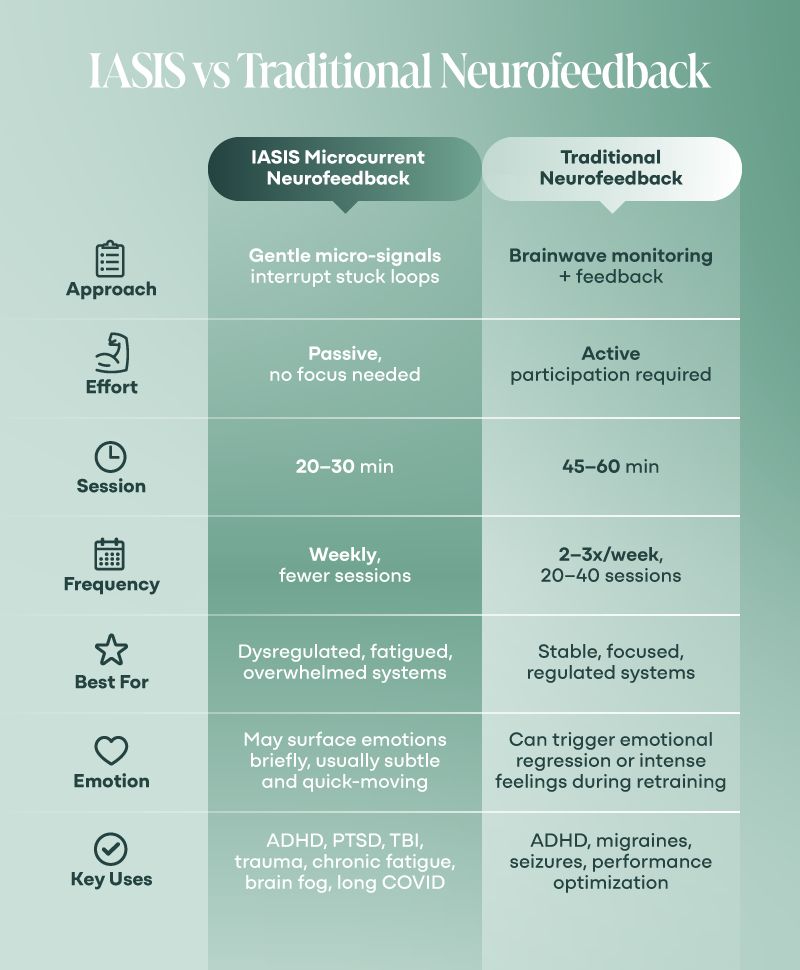
- Sessions are long. Expect 45-60 minutes, 2-3 times per week.
- Results are gradual. Most people need 20-40 sessions to see lasting change.
- It requires effort. You’re training your brain through concentration and consistency.
- It’s protocol-heavy. Practitioners often create complex custom programs based on brain maps (QEEG scans) and symptom tracking.
This means it works best for people who are already regulated enough to handle structure and repetition—those who can sit still, stay focused, and return repeatedly for several weeks or months.
If you’re already overwhelmed, depleted, or deeply dysregulated, traditional neurofeedback can feel like asking a short-circuiting lightbulb to power a stadium. This just means it’s not always the right fit for every stage of healing.
IASIS vs Traditional Neurofeedback: What Makes It Different?
By now, you’re probably thinking, “Okay, they both do something with brainwaves… but which one is actually going to help me feel like myself again?”
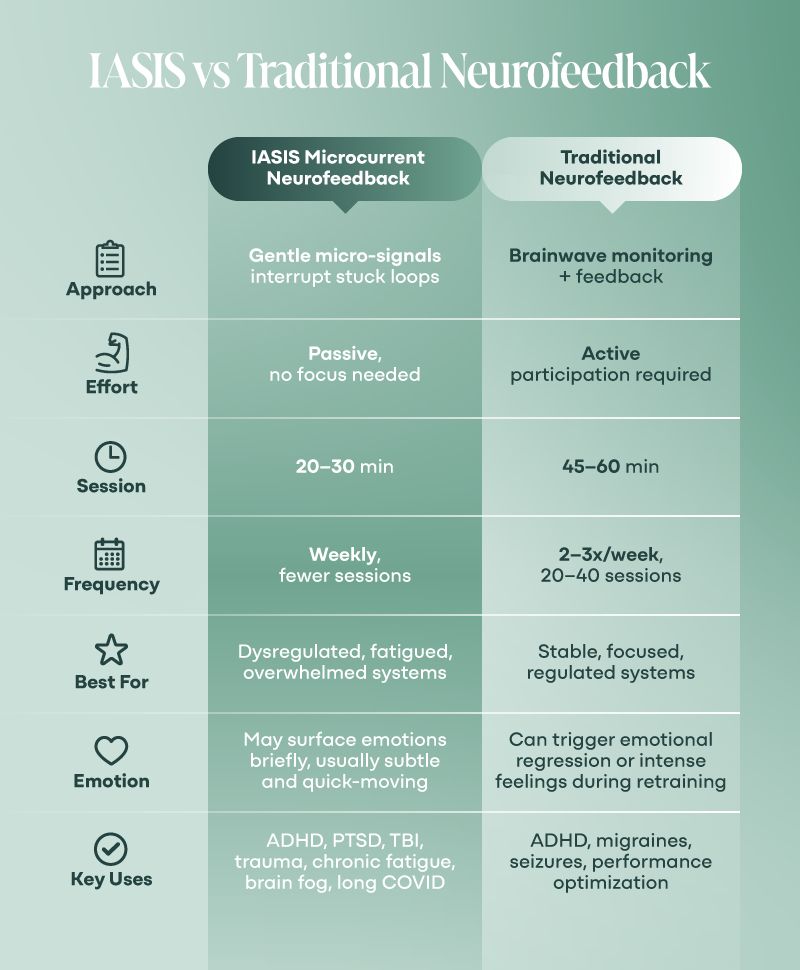
Let’s compare them side by side in plain speak that your nervous system can understand.
1. Passive Reset vs. Active Training
- IASIS: You don’t have to do anything. It gently interrupts stuck patterns so your brain can reorient.
- Traditional Neurofeedback: You’re in the driver’s seat, actively learning new patterns by responding to feedback. Think cognitive boot camp.
- TL;DR: IASIS resets the system. Traditional neurofeedback retrains it.
2. How Fast You Feel It
- IASIS: Most people feel something shift within the first 1-3 sessions: More calm, better sleep, less irritability.
- Traditional: Progress tends to be gradual and cumulative. Some people don’t notice big changes until 10+ sessions in.
- TL;DR: IASIS is often faster-acting, especially when your system is already overloaded.
3. Time Commitment
- IASIS: Sessions are ~30 minutes. A typical series might include 10-15 sessions (1-2x/week), depending on your goals.
- Traditional: You’re looking at 20-40+ sessions, often 2-3 times per week, to see lasting change.
- TL;DR: If your energy is limited, IASIS is less demanding on both your calendar and your bandwidth.
4. Nervous System Sensitivity
- IASIS: Designed with fragile systems in mind. Ideal for people with chronic symptoms, trauma, mold illness, or neurotoxic burden.
- Traditional: Can be overstimulating if your nervous system is already in survival mode or highly reactive.
- TL;DR: Sensitive system? IASIS plays nice.
5. Conscious Effort Required
- IASIS: You don’t have to concentrate, try hard, or even be awake for it to work. (Yes, people nap during sessions.)
- Traditional: Requires focus, attention, and compliance. You’re part of the training process.
- TL;DR: If mental fog, overwhelm, or fatigue are major players in your story, IASIS won’t ask for energy you don’t have.
6. Emotional Detox vs Emotional Reprocessing
- IASIS: May bring up old emotions briefly as the nervous system releases tension, but it’s often subtle and quick-moving.
- Traditional: Some people experience emotional regression or intense feelings as they retrain brainwaves, especially around trauma.
- TL;DR: IASIS can be a gentler door for emotional healing, without forcing you to relive what your body’s trying to release.
7. Complexity & Cost Over Time
- IASIS: Fewer sessions, simpler setup, and often lower total cost.
- Traditional: More sessions, more time, and often more expensive.
- TL;DR: For many, IASIS offers faster results with fewer logistics, which matters when you’re already investing so much in your healing.
Bottom Line
- If you’re in the early stages of detox, post-trauma recovery, or nervous system recalibration, IASIS may be the better fit.
- If you’re in a more stable place and want to sharpen focus, improve performance, or rebuild after brain injury, traditional neurofeedback can be powerful.
It’s about meeting your system where it’s at and choosing the tool that matches your body’s current capacity.
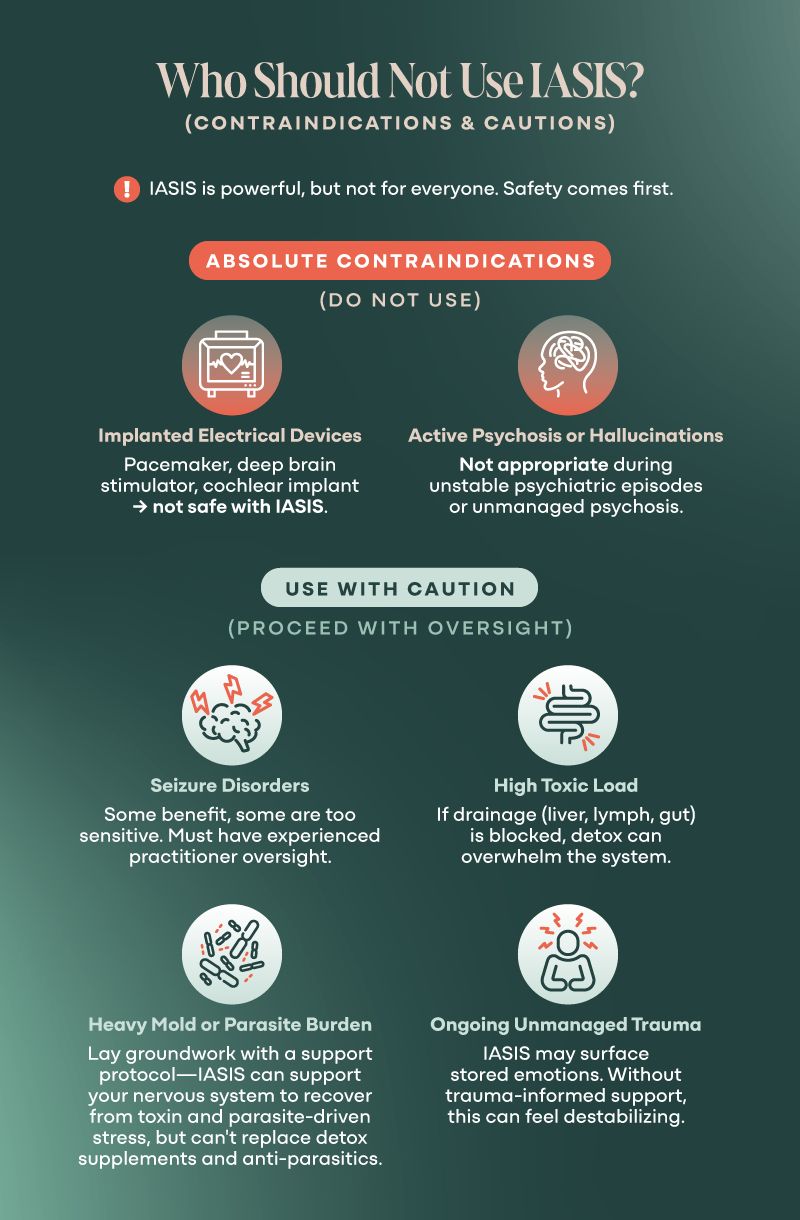
Who Should Not Use IASIS? (Contraindications & Cautions)
IASIS is powerful, but it’s not for everyone.
Like any tool, it needs the right conditions to work with your body, not against it.
Before you book that first session and start imagining your brain doing backflips into regulation, here’s what you need to know.
Absolute Contraindications
These are non-negotiable nos for IASIS:
- Implanted electrical devices: If you have a pacemaker, deep brain stimulator, cochlear implant, or similar device, IASIS is not for you. Even though the signal is tiny, we don’t take chances with embedded electronics. Your safety comes first.
- Active psychosis or hallucinations: IASIS may not be appropriate during unstable psychiatric episodes or unmanaged psychosis. It’s not designed to replace psychiatric care, and it shouldn’t be used in place of a supportive team if that’s what’s needed.
Use With Caution
These situations don’t mean IASIS is off the table, but you’ll want to proceed with extra care and practitioner oversight:
- Seizure disorders: Some people with seizure history benefit greatly from IASIS. Others may be too sensitive to brain stimulation, even in microcurrent form. Always consult with a provider who has experience using IASIS with epilepsy or seizure-prone clients.
- High toxic load: IASIS can kickstart detox. That’s great. Unless your drainage pathways are backed up like a clogged sewer. If you’ve never supported your liver, lymph, or gut before, don’t skip this step. Detox must come with drainage, or you risk a storm of re-circulated toxins.
- Heavy mold or parasite burden: If you’re still living in mold, or actively infected without any support protocols in place, your brain may try to regulate while your body’s still under attack. We always recommend laying groundwork first.
- Unmanaged trauma: IASIS can release emotional tension stored in the body. That’s not bad, but if you don’t have trauma-informed support (or a plan for what to do if emotions surface), it can feel destabilizing. Healing should feel like relief, not chaos.
Ask Yourself First
- Is my body ready for healing or still stuck in survival mode?
- Am I working with a practitioner who understands nervous system regulation, not just symptom suppression?
- Do I have support in place for detox, drainage, and emotional processing?
Because IASIS will move energy.
The key is making sure your system has somewhere safe to send it.
Choosing the Therapy That Matches Your Goals and Symptoms
You’ve probably figured out by now: this isn’t a one-size-fits-all situation. (Nothing in real healing ever is.)
What works for your neighbor’s ADHD or your co-worker’s panic attacks might be completely wrong for your mold-triggered fatigue or post-viral brain fog.
So before you commit to either IASIS or traditional neurofeedback, here’s how to match your therapy choice to your actual needs (not the ones that get you the most “likes” on Instagram).
If You’re in Survival Mode
Burned out, foggy, anxious, can’t sleep, can’t focus, can’t think your way through a grocery list, IASIS is likely the better fit.
Your nervous system doesn’t need more training; it needs space to reset.
IASIS gently interrupts the overwhelm so your brain can take a breath.
No doing, no forcing, no “pushing through.”
If You’re Stable, but Want to Optimize
Boosting focus, sharpening cognition, enhancing performance, prepping for a big life shift or creative project, traditional neurofeedback might serve you well.I
f your system has capacity, and you enjoy structure and long-term routines, this kind of brain training can fine-tune your mental game. (But if optimizing time is important, choose IASIS).
If You’ve “Done the Work,” but Still Feel Stuck
You’ve processed the trauma, handled the mold, cleaned up your gut, but something still feels stuck in the wiring, IASIS can help your brain catch up to the rest of your healing. It’s not about doing more, it’s about clearing what’s still in the way.
If You’re Mid-Detox or Healing From Chronic Illness
Especially if you’re navigating EMF sensitivity, mast cell issues, multiple chemical sensitivity, or mystery flares: IASIS often works better with sensitive systems. It supports regulation without overstimulating.
And when paired with drainage and toxin release protocols, it can accelerate results.
Quick Reminder
This isn’t about picking the “best” therapy, it’s about listening to the signals your body is already sending.
Symptoms are breadcrumbs. Choose the path that doesn’t ask your body to sprint when it’s still learning how to walk again.
You’re not behind. You’re not broken. You’re just ready for a new approach that meets you where you are.
IASIS as Part of a Wellness Routine
IASIS isn’t meant to be your one-and-done miracle. (Because if those existed, you wouldn’t still be reading this.)
Instead, IASIS works best as a strategic support tool inside your wider healing process.
It’s not the whole plan; it’s the nervous system reset button that helps every other part of the plan work better.
How to Think About IASIS
You can think of IASIS like cleaning the windshield on your healing car.
If you’re trying to detox, regulate, digest, or emotionally process through a fogged-up windshield, everything takes longer and feels harder.
But once you get that clarity? You’re still the one driving, only now, you can see where you’re going.
How Often Should You Do IASIS?
It depends on what your body’s carrying and how fast it likes to move. But here’s a general rhythm most folks respond well to:
Phase 1: Reboot the Brain
- Frequency: 1–2x per week
- Duration: 3–6 weeks
- This is where the most noticeable shifts tend to happen: Less reactivity, deeper sleep, calmer mornings. Keep it consistent during this phase so your brain builds momentum.
Phase 2: Integration + Support
- Frequency: 1x every 1–2 weeks
- Duration: 1–2 months
- Now your brain’s learning how to regulate on its own. IASIS becomes a gentle reminder, not a crutch.
Phase 3: Maintenance + Resilience
- Frequency: 1x/month or as needed
- Perfect if you’ve had a setback, travel, stress spike, or just want to stay in that flow state longer.
What to Pair It With (for Maximum Impact)
IASIS plays best with others. It works beautifully alongside:
- Detox + drainage protocols (because toxins love a dysregulated brain)
- Trauma-informed care (you don’t have to relive it to release it)
- Sleep repair and circadian rhythm reset
- Nervous system tools like breathwork, Vagus nerve toning, and lymphatic movement
- EMF hygiene (because yes, your brain is listening to your Wi-Fi signal)
Reminder: Detox without nervous system support is re-traumatizing.
But nervous system repair without detox is just rearranging furniture in a burning house.
You need both.
Make It Sustainable
If you’re juggling work, caregiving, symptoms, and six supplement protocols, your brain doesn’t need more pressure. What it needs is permission to rest, release, and reorganize itself safely.
That’s what IASIS offers.
And the beauty is: once your nervous system remembers how to regulate, you don’t need to micromanage it anymore.
You just keep setting the conditions, and your body does what it already knows how to do.
Final Thoughts: Your Brain Isn’t Broken, It’s Just Asking for a New Strategy
If you’ve been stuck in chronic symptoms, mental chaos, or emotional shutdown for so long that it’s started to feel like your personality, I see you.
You’re probably just operating from a nervous system that’s been stuck in survival mode for years, maybe even decades.
IASIS and traditional neurofeedback are both valid tools. But they’re tools, not saviors.
The real goal isn’t better brainwaves.
It’s freedom, clarity, resilience. That spark of “I feel like me again.”
Whether your next step is booking an IASIS session, exploring traditional neurofeedback, or just finally resting without guilt, you’re not behind. You’re right on time.
FAQs
1. What’s the main difference between IASIS and traditional neurofeedback?
IASIS is passive. It resets your brain gently without you doing anything. Traditional neurofeedback is active. You train your brain using screens, games, or sounds in real time.
2. Will I feel anything during an IASIS session?
Most people don’t feel the signal itself, it’s that subtle. But many feel calmer, clearer, or more grounded after the session. Some nap. Some cry. Some go home and clean their closet at 2AM. (It’s all normal.)
3. How soon will I notice results with IASIS?
Some people feel a shift after the first session. Others need 2–3 to notice changes. Either way, results are cumulative and gentle enough for even the most sensitive systems.
4. How many sessions of IASIS do I need?
A typical series is 10–15 sessions, often 1–2x/week. After that, it depends on your goals—some people move into monthly maintenance, others return only when life gets crunchy.
5. Is IASIS safe if I have mold illness, chronic fatigue, or post-viral symptoms?
Yes, and it’s often especially helpful for these. Just be sure your detox and drainage pathways are supported, since IASIS can nudge your system to start releasing junk.
6. Who shouldn’t do IASIS?
Anyone with implanted electrical devices (like a pacemaker), active psychosis, or unmanaged psychiatric conditions should avoid it. It’s also not a DIY substitute for psychiatric care.
7. Do I need a brain map (QEEG) to start IASIS?
Nope. IASIS doesn’t require any pre-testing or custom programs. It’s simple, intuitive, and practitioner-guided. No need to overcomplicate it.
8. Can IASIS help with trauma?
Yes, but it doesn’t force you to relive it. IASIS can gently release stored emotional tension without triggering re-traumatization. That said, trauma-informed support is always a good idea.
9. What if I’ve tried everything and nothing’s worked?
That probably means your brain’s still in survival mode and IASIS might be exactly what helps it finally shift. It’s not about doing more. It’s about doing what works with your nervous system,
References (22)
- Bauer R, Fels M, Royter V, Raco V, Gharabaghi A. Closed-loop adaptation of neurofeedback based on mental effort facilitates reinforcement learning of brain self-regulation. Clin Neurophysiol. 2016 Sep;127(9):3156-3164.
- Courrèges M, Hoareau M, Levenes C, Rahioui H. Comparative efficacy of neurofeedback, tDCS, and TMS: The future of therapy for adults with ADHD. A systematic review and meta-analysis. J Affect Disord. 2025 Nov 1;388:119585.
- Dicks LMT. Our Mental Health Is Determined by an Intrinsic Interplay between the Central Nervous System, Enteric Nerves, and Gut Microbiota. IJMS. 2023;25(1):38. doi:10.3390/ijms25010038
- Duke G, Yotter CN, Sharifian B, Duke G, Petersen S. The effectiveness of microcurrent neurofeedback on depression, anxiety, post-traumatic stress disorder, and quality of life. Journal of the American Association of Nurse Practitioners. 2024;36(2):100-110.
- Eva Otzen-Wehmeyer O. INTEGRATION OF MICROCURRENT NEUROFEEDBACK IN CLINICAL BIO-AND NEUROFEEDBACK PRACTICE. Published online March 3, 2024.
- Fehmi LG, Shor SB. Open focus attention training. Psychiatr Clin North Am. 2013 Mar;36(1):153-62.
- Hamada T, Seki M, Nango E, Shibata T, Imai S, Miyata T. Enhancing effects of exercise and neurofeedback: A systematic review and meta-analysis of computer game-based interventions for pediatric ADHD. Psychiatry Res. 2025 Jun;348:116447.
- Huang MX, Swan AR, Angeles Quinto A, et al. A pilot treatment study for mild traumatic brain injury: Neuroimaging changes detected by MEG after low-intensity pulse-based transcranial electrical stimulation. Brain Injury. 2017;31(13-14):1951-1963.
- Lubianiker N, Paret C, Dayan P, Hendler T. Neurofeedback through the lens of reinforcement learning. Trends Neurosci. 2022 Aug;45(8):579-593.
- Martin, D. M., Moffa, A., Nikolin, S., Bennabi, D., Brunoni, A. R., Flannery, W., Haffen, E., McClintock, S. M., Moreno, M. L., Padberg, F., Palm, U., & Loo, C. K. (2018, July). Cognitive effects of transcranial direct current stimulation treatment in patients with major depressive disorder: An individual patient data meta-analysis of randomised, sham-controlled trials - PubMed. Neuroscience & Biobehavioral Reviews; Elsevier BV.
- May G, Benson R, Balon R, Boutros N. Neurofeedback and traumatic brain injury: a literature review. Ann Clin Psychiatry. 2013 Nov;25(4):289-96.
- Mirifar A, Keil A, Ehrlenspiel F. Neurofeedback and neural self-regulation: a new perspective based on allostasis. Rev Neurosci. 2022 Feb 7;33(6):607-629.
- Moffa, A. H., Martin, D., Alonzo, A., Bennabi, D., Blumberger, D. M., Benseñor, I. M., Daskalakis, Z., Fregni, F., Haffen, E., Lisanby, S. H., Padberg, F., Palm, U., Razza, L. B., Sampaio-Jr, B., Loo, C., & Brunoni, A. R. (2020, April). Efficacy and acceptability of transcranial direct current stimulation (tDCS) for major depressive disorder: An individual patient data meta-analysis - PubMed. Progress in Neuro-Psychopharmacology and Biological Psychiatry; Elsevier BV.
- Omejc N, Rojc B, Battaglini PP, Marusic U. Review of the therapeutic neurofeedback method using electroencephalography: EEG Neurofeedback. Bosn J Basic Med Sci. 2019 Aug 20;19(3):213-220.
- Pamplona GSP, Zweerings J, Lor CS, deErney L, Roecher E, Taebi A, Hellrung L, Amano K, Scheinost D, Krause F, Rosenberg MD, Ionta S, Brem S, Hermans EJ, Mathiak K, Scharnowski F. Neural Mechanisms of Feedback Processing and Regulation Recalibration During Neurofeedback Training. Hum Brain Mapp. 2025 Jul;46(10):e70279.
- Papo D. Neurofeedback: Principles, appraisal, and outstanding issues. Eur J Neurosci. 2019 Jun;49(11):1454-1469.
- Richer R, Zenkner J, Küderle A, Rohleder N, Eskofier BM. Vagus activation by Cold Face Test reduces acute psychosocial stress responses. Sci Rep. 2022;12(1). doi:10.1038/s41598-022-23222-9
- Sauvaget, A., Lagalice, L., Schirr-Bonnans, S., Volteau, C., Péré, M., Dert, C., Rivalland, A., Tessier, F., Lepage, A., Tostivint, A., Deschamps, T., Thomas-Ollivier, V., Robin, A., Pineau, N., Cabelguen, C., Bukowski, N., Guitteny, M., Beslot, A., Simons, L., … Riche, V.-P. (2020). Cost-utility analysis of transcranial direct current stimulation (tDCS) in non-treatment-resistant depression: the DISCO randomised controlled study protocol. BMJ Open, 10(1), e033376.
- Sulzer J, Papageorgiou TD, Goebel R, Hendler T. Neurofeedback: new territories and neurocognitive mechanisms of endogenous neuromodulation. Philos Trans R Soc Lond B Biol Sci. 2024 Dec 2;379(1915):20230081.
- Thibault RT, MacPherson A, Lifshitz M, Roth RR, Raz A. Neurofeedback with fMRI: A critical systematic review. Neuroimage. 2018 May 15;172:786-807.
- Van Doren J, Arns M, Heinrich H, Vollebregt MA, Strehl U, K Loo S. Sustained effects of neurofeedback in ADHD: a systematic review and meta-analysis. Eur Child Adolesc Psychiatry. 2019 Mar;28(3):293-305.
- What is Neurofeedback Therapy | IASIS Technologies. (n.d.)
This article is for general education and is not a substitute for personal medical advice.