If you’re reading this, chances are you’re no stranger to the feeling of being stuck inside your own head.
Maybe your mind loops through the same anxious thoughts no matter how many times you tell yourself to “just calm down.”
Maybe you snap at people you love, then lie awake replaying it in your mind.
Maybe you go through whole days numb—not sad exactly, just like you’re watching your own life through foggy glass.
You’ve probably tried things: therapy, journaling, meditation apps, cutting sugar, maybe even that stack of supplements you now eye with quiet resentment on your kitchen counter.
And yet here you are, still searching.
Anxiety, depression, and PTSD aren’t just emotional or psychological states.
They’re bioelectrical patterns in your brain and nervous system.
Your brain gets caught in survival mode, and no amount of positive thinking can override a system that’s been set to “danger.”
That’s where IASIS microcurrent neurofeedback comes in.
You don’t have to rehash your past, push through symptoms, or medicate yourself into silence.
It’s about gently nudging your brain’s natural ability to regulate itself, so you can finally experience something you may not even remember: calm, clarity, and connection.
And no, it’s not just for “other people” who have it worse.
You deserve tools that help you come home to yourself again.
Let’s talk about how.
Key Takeaways
- Chronic stress can make you lose resilience and keep you stuck in old patterns.
- IASIS helps your brain remember how to regulate itself.
- Even if you’ve been stuck for years, your body hasn’t forgotten how to heal.
What Is IASIS & How Does It Work?
Let’s get this out of the way: IASIS is not zapping your brain.
(Many people hear the term “microcurrent neurofeedback” and picture something between a sci-fi helmet and a cattle prod. It’s neither.)
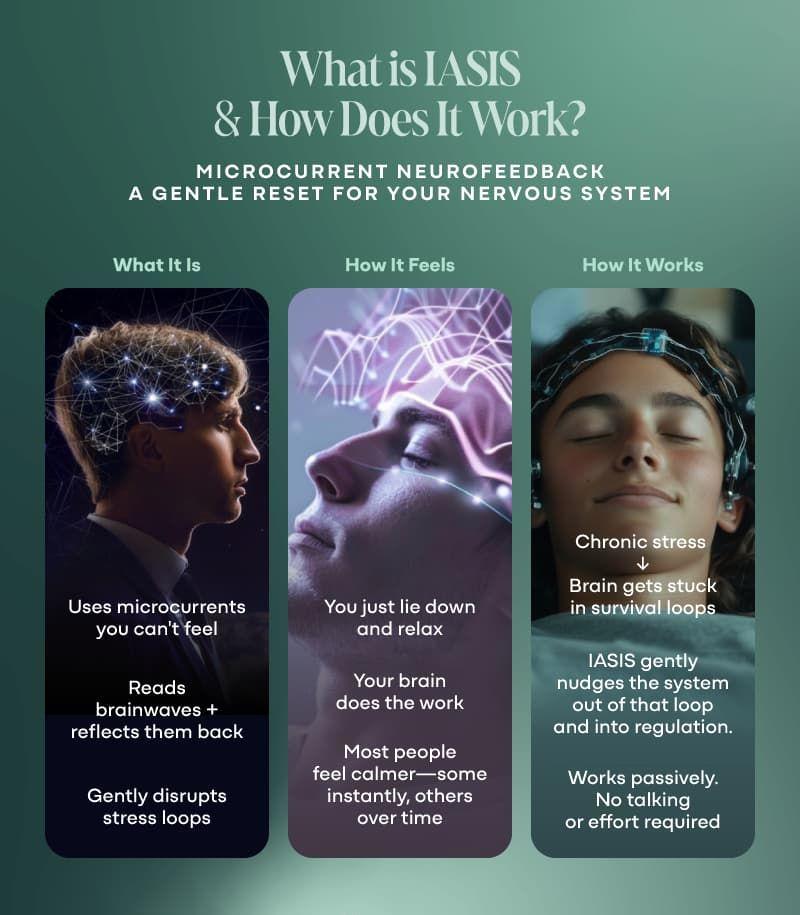
IASIS is a gentle, non-invasive technology that uses ultra-low microcurrents (so low you can’t feel them) to help your brain recognize and release stuck stress patterns (1, 2, 6).
Tiny electrodes placed on the scalp read your brain’s natural electrical activity and send back a whisper-light signal, like holding up a mirror to your brainwaves (3, 6, 7).
Here’s why that matters:
When you’ve been through chronic stress, trauma, or toxic exposures, your brain gets locked into survival circuits.
Think of it like a record stuck in a groove. No matter how hard you want to move on, your system keeps replaying the same stress loop: hypervigilance, shutdown, panic, exhaustion.
IASIS targets your entire brain and gently disrupts those loops, nudging the nervous system toward a more balanced, regulated state (1, 7).
Unlike therapies that ask you to consciously process your trauma, IASIS works passively, below the level of thought (3, 6, 7).
You don’t have to “do” anything during a session. Your brain and body do the work on their own.
Most people experience it as lying comfortably while their brain starts sorting itself out.
Some feel calmer or clearer right away; others notice changes over several sessions.
How Does IASIS Relate to Microcurrent Neurofeedback?
If you’ve heard of neurofeedback before, you might be wondering how IASIS is different.
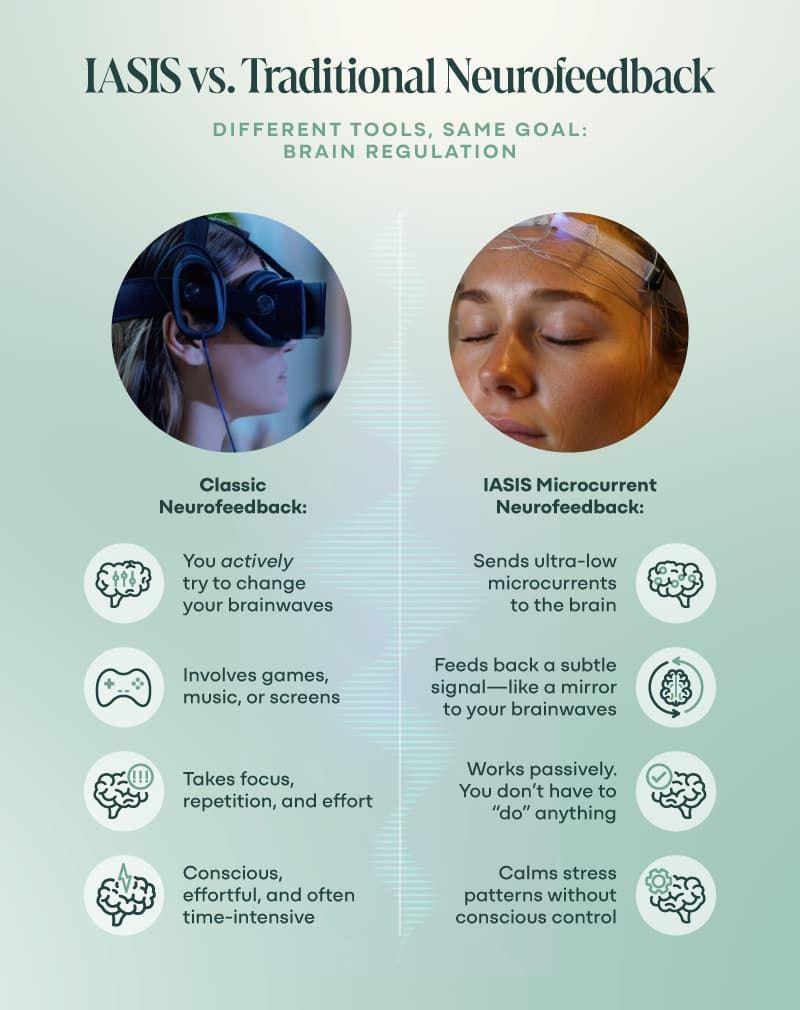
Here’s the short answer: IASIS is a type of microcurrent neurofeedback, but it works very differently from the traditional brain training you might have seen on podcasts or in biohacking circles (1, 3, 6).
In classic neurofeedback, you’re hooked up to sensors, and you actively work to change your brainwaves, maybe by focusing on a video game or meditation track that gives you real-time feedback when you hit the “right” brainwave pattern.
It’s conscious, effortful, and usually takes dozens of sessions.
IASIS takes a totally different approach.
Instead of asking you to control your brainwaves, it feeds back an ultra-low microcurrent signal that the brain automatically responds to with no conscious effort required.
Imagine this: When IASIS sends its ultra-low microcurrent signals to your brain, your neurons recognize, “Hey, this feels electrical, like me” — but then they hit a wall.
The frequencies are just unfamiliar enough that your brain can’t make sense of them (2).
Instead of shutting down, your brain does something brilliant: it leans in.
It starts reshuffling old communication patterns, stepping out of the rigid, stuck loops it’s been clinging to, and exploring new ways to connect.
Neurons begin rewiring their conversations, building fresh neural pathways (2).
This process of rewiring and reorganizing is what neuroscience calls neuroplasticity.
But our team likes to think of it as your brain remembering that it’s adaptable, that it can learn a new rhythm, and that healing is possible, even after years of feeling locked in survival mode.
You’re not trying to “win” at calm or “fix” your brain; you’re letting your brain do what it’s built to do: self-regulate.
This is why IASIS can be so helpful for people with anxiety, PTSD, depression, brain fog, or chronic stress (1, 2, 5, 6), conditions where the very idea of trying harder can make symptoms worse.
If you’re exhausted, overwhelmed, or have been living in survival mode for years, IASIS offers something radical: support without strain.
Neuroplasticity Through the Lens of Bioregulatory Medicine
In plain language, neuroplasticity just means your brain is changeable.
It’s constantly rewiring itself in response to experience, environment, and inputs, for better or worse.
Yep, your brain and body are designed to respond to stress.
When you face a challenge, your blood pressure rises, your heart beats faster, your breath quickens, and your brain sparks into high gear (2).
From a bioregulatory medicine perspective, your symptoms (whether that’s panic attacks, brain fog, insomnia, or depression) are the body’s logical response to overwhelm.
It’s your brain and nervous system doing their best to protect you in a world that’s been too much, for too long.
This is your biology’s way of helping you rise to the occasion, handle the threat, and then (here’s the key part) slide back into a state of rest and recovery.
In a healthy system, this cycle (stress, recovery, reset) is automatic, like a pendulum swinging smoothly between action and rest.
But when that system gets overwhelmed by chronic stress, trauma, toxins, or all the above, the pendulum gets stuck.
The body loses its ability to toggle between tension and ease, between “go” and “rest” (2).
That’s when resilience takes a hit.
Instead of bouncing back, you’re left simmering in survival mode.
Over time, this can snowball into exhaustion, burnout, chronic pain, autoimmune issues, irritability, anxiety, emotional numbness, or the dreaded “why did I just walk into this room?” brain fog.
The good news? Just because your system has forgotten how to downshift doesn’t mean it can’t relearn.
And here’s the opportunity: the same wiring that got stuck in survival mode can also rewire toward safety, connection, and resilience.
IASIS works by giving the brain a gentle interrupt, a “Hey, you can loosen your grip now” signal.
It taps into the brain’s own plasticity, helping it shift out of old stress patterns and reorganize itself.
Our team likes to think of it like this: If your brain has been stuck repeatedly playing the same anxious piano chord, IASIS slips in a few new notes and suddenly, the whole song can start to change.
IASIS works with your body’s natural intelligence, letting healing happen through alignment, not attack.
How Can IASIS Help Treat Anxiety, Depression, and PTSD?
If you live with anxiety, depression, or PTSD, you know it’s not “just in your head,” it’s in your whole system.
Your chest tightens.
Your sleep breaks down.
Your gut rebels.
Your mind spins at 2 a.m., replaying every mistake you’ve ever made, or worse, you go completely numb and can’t feel anything at all.
IASIS helps by gently interrupting these survival patterns and giving the brain space to remember regulation.
Here’s what that looks like under the hood:
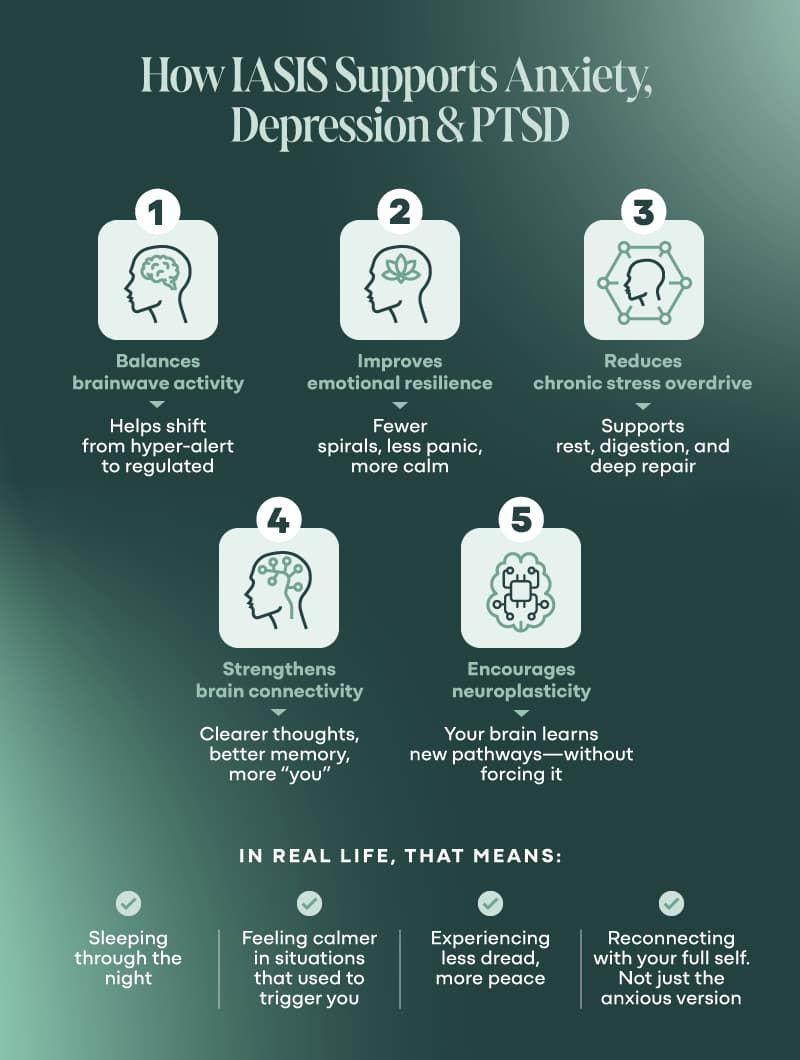
- Promotes balanced brainwave activity When your brain is stuck in chronic stress, certain regions like the amygdala, your brain’s fear center, are overactive, while areas responsible for calm, focus, and connection are underactive. IASIS helps smooth out this imbalance, encouraging the brain to shift from “red alert” to a more flexible, responsive state (7).
- Improves emotional regulation Many clients report fewer emotional swings, less panic, and a greater sense of resilience, not because they’re numbing out, but because their nervous system stops overreacting to everyday triggers (7). You’re no longer living at the mercy of every text message, memory, or stressful thought.
- Reduces stress-related overactivity Think of chronic stress like a motor that’s been revving for years. IASIS helps dial back that overactivity so your body can come out of fight-or-flight mode and rest, digest, repair, and feel human again (7).
- Supports healthier neural connectivity Research suggests IASIS improves communication between different brain regions, which helps explain why people often notice clearer thinking, better memory, and a sense of being “more themselves” after a series of sessions (2, 7).
- Encourages the brain’s natural ability to self-regulate (neuroplasticity) This is the heart of it: IASIS doesn’t force or override. It works with your brain’s own brilliance, inviting it to update its stress maps and create new pathways toward balance (7).
What does allll this mean in real life?
- Feeling calmer in situations that used to send you spiraling.
- Sleeping through the night without jolting awake.
- Walking into your day without the heavy backpack of dread you’ve been carrying for years.
- Having more “you” available, and not just the anxious or depressed version you’ve come to expect.
And the best part: it’s not another medication or practice you have to “keep up with.”
It’s your system doing what it was designed to do: adapt, regulate, and heal.
One of our most favorite (and humbling) moments is when a client who’s been trying everything says, “Wait… was it supposed to work this fast?”
Not because it’s magic, but because their brain was ready for a new pattern all along.
Who Is a Candidate for IASIS?
So, is IASIS for you?
If you’re dealing with anxiety, depression, PTSD, brain fog, post-concussion symptoms, migraines, or burnout, you may be a good candidate (1, 2, 3, 5, 6).
It’s also used by people recovering from long-term stress, addiction, toxic exposures, or neurological challenges like chemo brain (2).
But IASIS isn’t a magic bullet.
If you’re looking for something to “fix you” while you keep burning the candle at both ends, skipping meals, ignoring trauma, or living in a toxic environment, it’s probably not the right fit right now.
IASIS works best when it’s part of a multilayered, root-cause approach: supporting your detox pathways, nourishing your body, regulating your nervous system, and giving yourself a fighting chance to heal.
You are the CEO of your health. No practitioner or device can do the healing for you.
That said, IASIS can be a deeply supportive tool for people who are ready to:
- Help their nervous system out of survival mode
- Reduce medication reliance (with medical supervision, of course)
- Improve resilience before, during, or after other therapies
- Give their body and mind a gentle nudge toward the healing it’s been working so hard to achieve
You don’t have to be a “perfect patient” or have your whole life figured out to benefit.
You just need curiosity and willingness to show up for yourself.
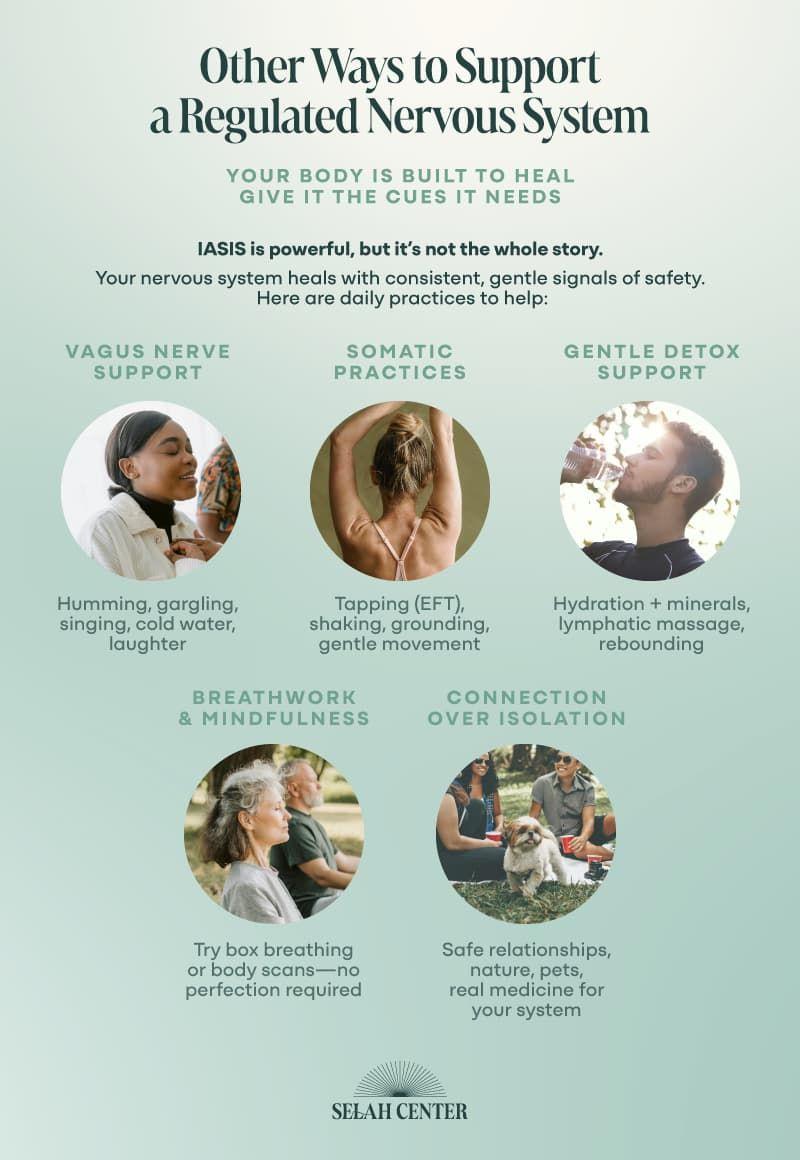
Other Tips to Calm the Nervous System and Heal from Trauma
While IASIS can be a powerful reset button, it’s not the whole picture.
Your nervous system doesn’t heal in isolation it heals through consistent, gentle signals of safety, day after day.
Here are simple, science-backed ways to help your system calm down and stay in a healing state:
- Daily Vagus nerve support Your Vagus nerve is like the brake pedal for your stress response. You can strengthen it with simple things like humming, gargling, singing, cold showers (start with just your face), or even deep belly laughs (8, 9). Laughing on purpose counts!
- Somatic practices Trauma is stored in the body, not just the mind. Gentle movement like shaking (literally, like an animal after stress), tapping (EFT), or grounding exercises can help discharge pent-up survival energy.
- Gentle detox supports If your body is overloaded with environmental toxins, it’s constantly signaling “danger” to your nervous system. Simple steps like hydration with trace minerals, lymphatic self-massage, or lymphatic movement (think gentle rebounding or walking) help lighten the load without fancy protocols.
- Breathwork or mindfulness (without force) The goal isn’t to “Zen out” perfectly. It’s to give your body small moments of safety. Try box breathing (inhale 4, hold 4, exhale 4, hold 4) or a simple body scan. And if your mind wanders? Great. You’re human.
- Prioritize connection over isolation We heal in connection, not in lockdown. Safe relationships, nature time, or even pet cuddles are legitimate nervous system medicine. You don’t have to “earn” them by feeling better first.
Here’s your permission slip: You are not fragile.
You are brilliantly adaptive.
Let’s give your body more of the inputs it’s already asking for, so it can keep moving toward resilience.
FAQs
1. How is IASIS different from other neurofeedback?
Traditional neurofeedback asks you to consciously change your brainwaves, like trying to meditate your way to calm or “win” at focus while hooked up to sensors. IASIS works passively. You don’t have to do anything but show up; the microcurrents gently nudge your brain into new patterns on their own. No gold stars required.
2. Is IASIS like a computer reboot for your brain?
Yes, but no one’s pulling the plug! Think of IASIS as a gentle system refresh. If your brain has been stuck running glitchy, outdated stress loops, IASIS helps disrupt those patterns so your system can reset, reorganize, and run more smoothly (2).
3. What kind of electrical impulses does IASIS use? Will I feel them?
IASIS uses ultra-low microcurrents, about 1/100th the power of a AA battery (2), around 3 picowatts (that’s 3 trillionths of a watt) (1). You won’t feel anything during a session; the signal is well below sensory perception. But your brain picks up on it and that’s what makes the magic happen.
4. How long does a treatment last, and how many do I need?
Sessions typically last 30–60 minutes, depending on your provider (1, 3, 7). Most people notice cumulative benefits after about 10 weeks (roughly one session per week), though some feel subtle shifts earlier (3). Healing isn’t a race; your nervous system will tell you when it’s ready for change.
5. Is IASIS safe? How do we know it works?
IASIS has been used safely for over 15 years with more than 75,000 people worldwide (7). Research and clinical outcomes show promising results for anxiety, depression, PTSD, traumatic brain injury, and more. It’s non-invasive, medication-free, and works with your body’s own self-regulating systems.
6. Will IASIS erase my memories or change my personality?
Nope. IASIS doesn’t “delete” anything, it just helps your brain stop reliving survival-mode loops on repeat. You’re still you, but a calmer, clearer version, with more access to joy, connection, and mental clarity.
7. How will I know if it’s working?
Many people notice small, subtle shifts: sleeping better, feeling less reactive, experiencing moments of calm where there was tension before. It’s not a dramatic overnight flip. It’s more like your nervous system remembering how to downshift, one step at a time.
8. Is IASIS just for people with mental health diagnoses?
Not at all. IASIS helps anyone whose nervous system has been stuck in overdrive: parents juggling too much, professionals in burnout, athletes recovering from injury, people healing from toxic exposures, or anyone feeling hijacked by stress.
9. Can IASIS replace therapy or medication?
IASIS isn’t a replacement for therapy or medication. It can, however, make therapy more effective by calming the system and can sometimes help people reduce medication (under doctor supervision), but it’s most powerful when combined with a root-cause healing approach.
10. What does it feel like during a session?
Most people feel… nothing! You’ll be sitting or lying down comfortably with small electrodes on your scalp, and you can rest, chat, or just be. Some people report a sense of calm or lightness afterward, but during the session itself, there’s no pain, buzzing, or zapping. We promise, no sci-fi helmets involved.
References (9)
- Duke G, Yotter CN, Sharifian B, Duke G, Petersen S. The effectiveness of microcurrent neurofeedback on depression, anxiety, post-traumatic stress disorder, and quality of life. Journal of the American Association of Nurse Practitioners. 2024;36(2):100-110.
- Eva Otzen-Wehmeyer O. INTEGRATION OF MICROCURRENT NEUROFEEDBACK IN CLINICAL BIO-AND NEUROFEEDBACK PRACTICE. Published online March 3, 2024.
- Huang MX, Swan AR, Angeles Quinto A, et al. A pilot treatment study for mild traumatic brain injury: Neuroimaging changes detected by MEG after low-intensity pulse-based transcranial electrical stimulation. Brain Injury. 2017;31(13-14):1951-1963.
- Martin, D. M., Moffa, A., Nikolin, S., Bennabi, D., Brunoni, A. R., Flannery, W., Haffen, E., McClintock, S. M., Moreno, M. L., Padberg, F., Palm, U., & Loo, C. K. (2018, July). Cognitive effects of transcranial direct current stimulation treatment in patients with major depressive disorder: An individual patient data meta-analysis of randomised, sham-controlled trials - PubMed. Neuroscience & Biobehavioral Reviews; Elsevier BV.
- Moffa, A. H., Martin, D., Alonzo, A., Bennabi, D., Blumberger, D. M., Benseñor, I. M., Daskalakis, Z., Fregni, F., Haffen, E., Lisanby, S. H., Padberg, F., Palm, U., Razza, L. B., Sampaio-Jr, B., Loo, C., & Brunoni, A. R. (2020, April). Efficacy and acceptability of transcranial direct current stimulation (tDCS) for major depressive disorder: An individual patient data meta-analysis - PubMed. Progress in Neuro-Psychopharmacology and Biological Psychiatry; Elsevier BV.
- Sauvaget, A., Lagalice, L., Schirr-Bonnans, S., Volteau, C., Péré, M., Dert, C., Rivalland, A., Tessier, F., Lepage, A., Tostivint, A., Deschamps, T., Thomas-Ollivier, V., Robin, A., Pineau, N., Cabelguen, C., Bukowski, N., Guitteny, M., Beslot, A., Simons, L., … Riche, V.-P. (2020). Cost-utility analysis of transcranial direct current stimulation (tDCS) in non-treatment-resistant depression: the DISCO randomised controlled study protocol. BMJ Open, 10(1), e033376.
- What is Neurofeedback Therapy | IASIS Technologies. (n.d.). Retrieved July 18, 2025.
- Richer R, Zenkner J, Küderle A, Rohleder N, Eskofier BM. Vagus activation by Cold Face Test reduces acute psychosocial stress responses. Sci Rep. 2022;12(1). doi:10.1038/s41598-022-23222-9
- Dicks LMT. Our Mental Health Is Determined by an Intrinsic Interplay between the Central Nervous System, Enteric Nerves, and Gut Microbiota. IJMS. 2023;25(1):38. doi:10.3390/ijms25010038
This article is for general education and is not a substitute for personal medical advice.