You probably don’t think about your scars much.
Most people don’t, until one starts acting up, itching, or tugging at you like a bad memory with teeth.
But your scars are part of your body’s electrical grid, and they can quietly short-circuit your healing.
Even if you don’t have visible scars from accidents or surgeries, you still have the original scar: the umbilical scar (AKA your belly button, AKA a root cause!).
That tiny mark is a neurological wildcard.
And if you’ve had a C-section, a hernia repair, dental surgery, or even a facelift (yes, especially the scars hidden in the hairline), those old incision sites may be holding onto more than you realized.
I’ve seen them block lymphatic flow, disrupt cranial bone movement, and muddle the messaging of the gut-brain axis in my clients.
This is where neural therapy comes in.
It’s a deeply rooted, bioregulatory approach to regulating the body’s electrical communication by addressing interference fields, those silent pockets of chaos created by scars, injuries, and old trauma.
Let’s take a closer look at how neural therapy works and why your body might be begging for it.
Key Takeaways
- Every scar tells a story, and your nervous system remembers it.
- Your symptoms might not be where the problem is.
- Neural therapy helps reset your body’s electrical communication system so you can heal.
What Is Neural Therapy? A Bioregulatory Perspective
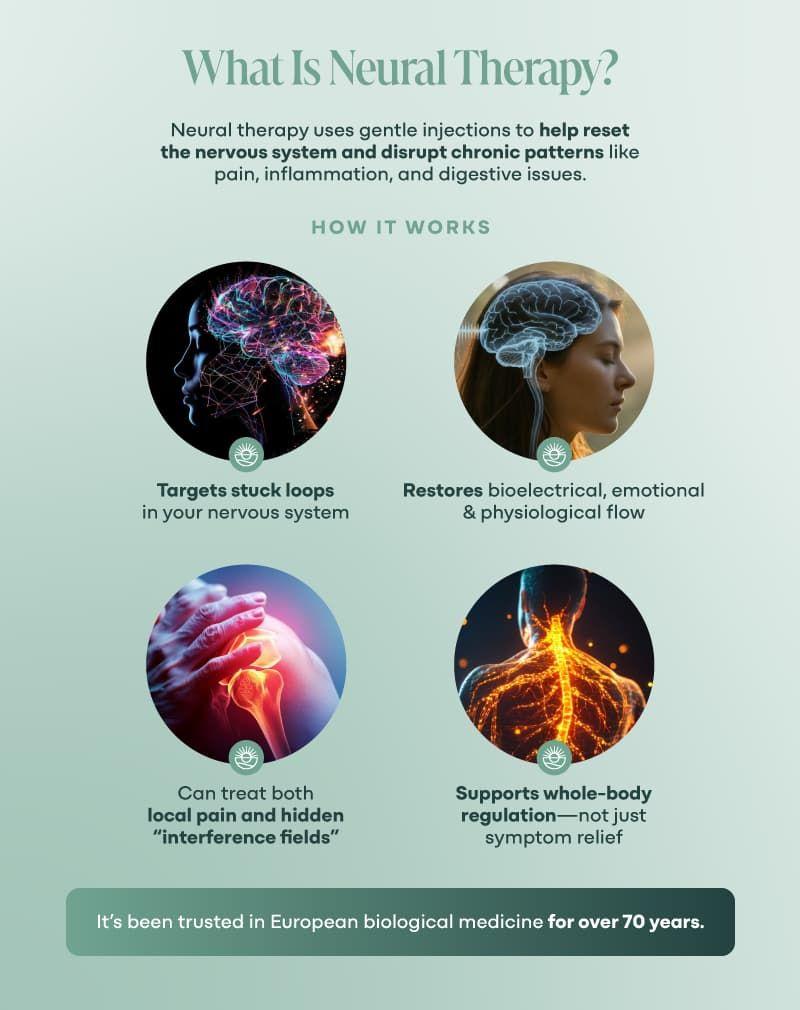
Neural therapy is a regulatory medicine technique that uses gentle injections (most commonly of a local anesthetic called procaine) to reset the body’s nervous system signaling and restore healthy regulation to organs, tissues, and energy systems (3, 6, 10).
That may sound technical, but here’s what it really means for you: If your body is stuck in a loop (pain that won’t quit, digestion that refuses to work, inflammation that flares for no good reason) neural therapy helps break the cycle by reminding your nervous system what normal feels like (3).
It’s like a reboot button for your biology.
Originally developed by German physicians Ferdinand and Walter Huneke in the 1920s, neural therapy has been a cornerstone of European biological medicine for over 70 years.
Treatment can be done locally (injected directly into irritated tissue); segmentally (injected into tissue with the same nerve supply as the irritated tissue); or via interference fields (more on this in a sec) (3, 4, 6, 12, 14, 15).
Neural therapy restores flow (bioelectrical, emotional, and physiological) and it’s been a trusted tool in bioregulatory clinics around the world to address conditions that just don’t respond to conventional approaches (14, 15).
Let’s say you have a decades-old appendectomy scar.
From the outside, it looks fine.
But inside, it may be causing an “interference field,” or a localized area that disrupts communication in your nervous system, draining energy and creating confusion in other parts of the body (3).
You might not feel anything at the scar site, but suddenly, your right shoulder starts hurting.
Or your immune system just can’t get its act together.
Neural therapy helps locate and resolve these interference fields with precision.
And the results can be immediate. (We’ll get into why later.)
But even when the effects are more subtle or take time to unfold, they’re often profound, especially when combined with nervous system support, detox strategies, and trauma-informed care.
Procaine: The Science Behind the Syringe
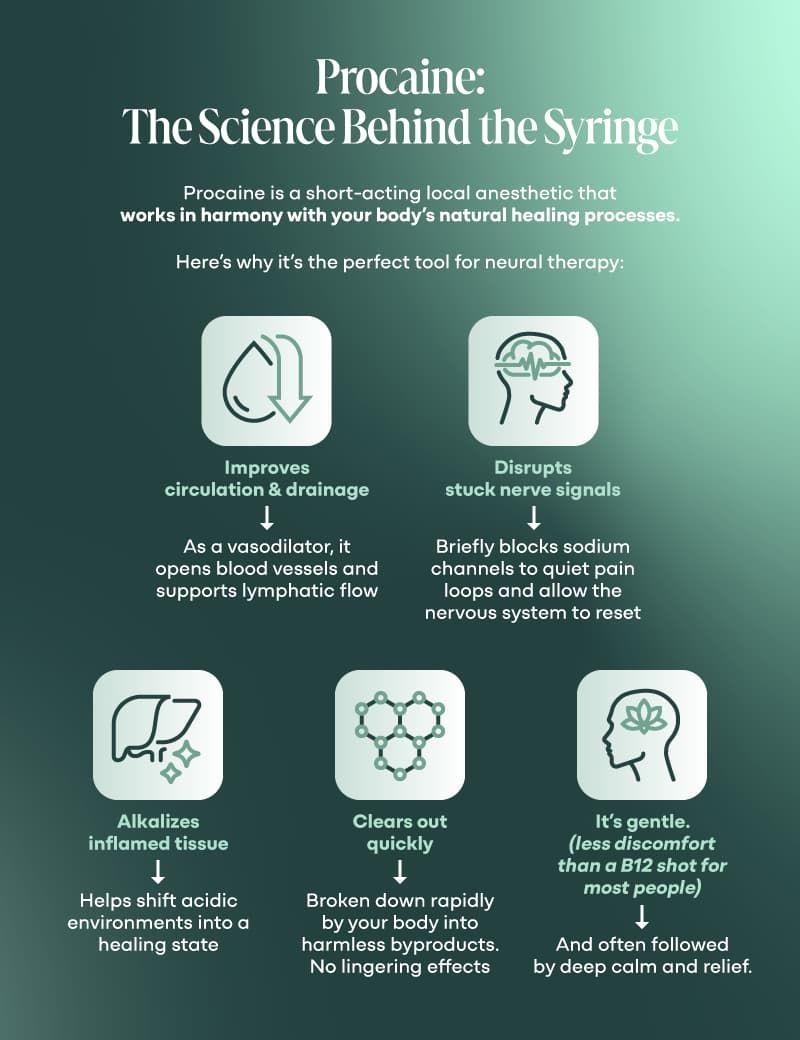
Procaine is an ester-based local anesthetic, and it’s the primary substance used in neural therapy (10).
It has a delayed onset and a short duration of action, which is exactly what we want (10).
It diffuses quickly through the tissues, breaks down easily in the bloodstream, and doesn’t linger or interfere with your body’s natural processes (10).
In other words, it does its job and gets out of the way.
It’s not blocking sensation or shutting anything down.
It’s inviting your body back online, with precision.
Here’s why procaine works so beautifully in neural therapy:
- It’s a vasodilator (10). That means it opens blood vessels, which improves circulation and lymphatic drainage in the treated area, often a scar, joint, organ reflex point, or nerve pathway.
- It disrupts stuck electrical patterns. Procaine temporarily blocks voltage-gated sodium channels, which are responsible for conducting pain and sensory signals along nerves (4, 10). This momentary “quiet” in the system allows the nervous system to reboot, re-pattern, and return to healthy signaling.
- It supports pH balance in tissues. Procaine is naturally alkaline, which helps shift acidic, inflamed tissues into a more healing-friendly environment. Think of it like prepping the soil before planting seeds.
- It’s metabolized quickly and safely. Thanks to enzymes in your plasma called pseudocholinesterases, procaine breaks down rapidly into harmless components, making it safe for most people, even those with chronic sensitivities.
You might be thinking, “Wait, you’re injecting anesthetic into scars and nerve points? Isn’t that a bit extreme?”
Actually, it’s incredibly gentle.
Most people report less discomfort than a B12 shot, and some don’t feel the needle at all. There can be temporary strong sensations as the body releases from the tissues, but it’s quickly followed by feelings of peace and well-being.
Scars Hold Stories
You probably already know that trauma lives in the body.
But did you know it often hides in your scar tissue (14, 15)?
When the body undergoes injury (surgical, accidental, or even emotional) the tissues can lock in more than just physical damage (14, 15).
They remember the pain, the fear, the anesthesia, the sense of violation or helplessness.
And sometimes, they remember the emotions of everyone else in the room, too.
One of the most common examples is C-section scars.
These abdominal scars are often tangled up with birth trauma, unmet expectations, fear for your baby’s safety, or feeling dismissed or out of control in the surgical suite.
That scar may seem healed on the outside, but underneath, it can be a live wire, tugging at your fascia, dysregulating your nervous system, and interrupting organ function in ways that show up months or years later (14, 15).
And here’s where things get weird in the best possible way:
- A facelift scar hidden in your hairline might be contributing to sinus issues or tension headaches.
- An old knee surgery can create shoulder pain on the opposite side.
- A belly button piercing (yes, really) can impact digestion, hormonal balance, even menstrual cycles.
- Dental scars (looking at you, wisdom tooth removal)
- Circumcision
- Episiotomy scars
- Also, consider organ distress linked to TCM emotion map (lungs = grief, kidneys = fear, small intestine = homeless or abandoned, liver = old anger, spleen = shocks and traumas, etc.)
Because it’s all connected.
Your fascia is one continuous web.
Your nervous system runs on communication and flow.
When you disrupt either, symptoms show up, often far from the site of the original injury (14, 15).
Neural therapy recognizes scars as neurological interference fields, or places where the body’s internal messaging got scrambled (14, 15).
By gently injecting those areas with procaine, we’re releasing the signal it’s been holding.
You’re carrying more than you realized, and Neural Therapy helps your body to release it.
How Neural Therapy Works: Resetting the Body’s Operating System
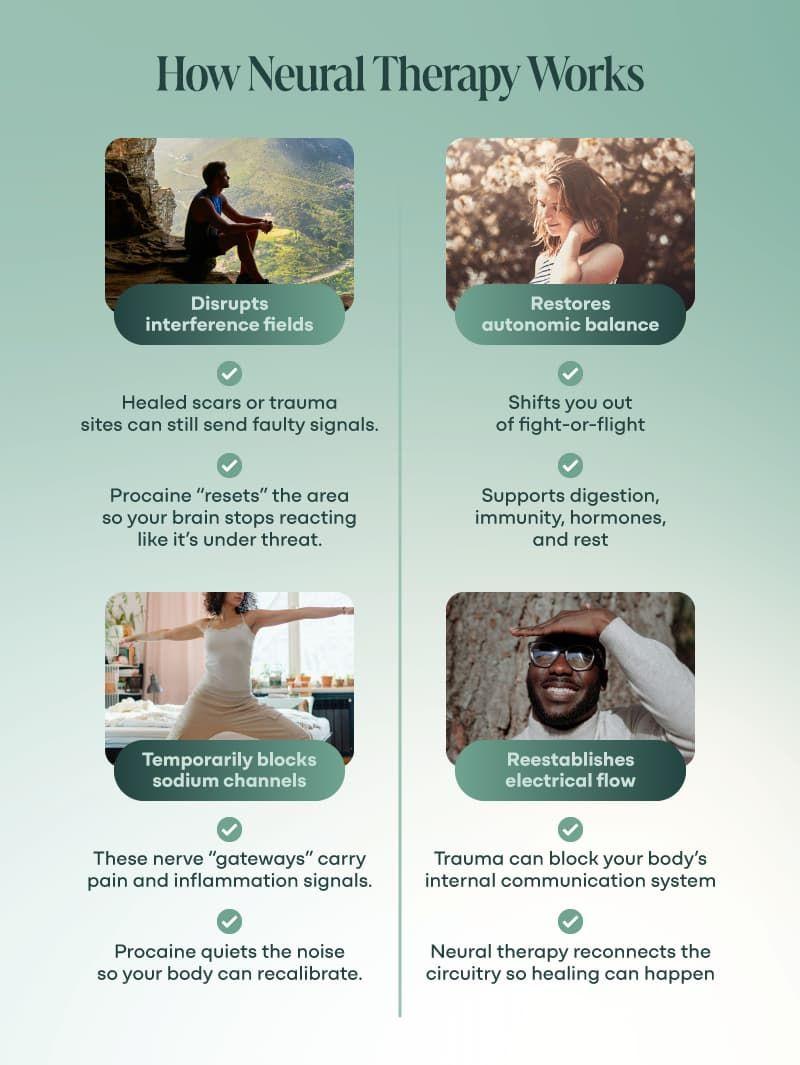
Neural therapy works by interrupting faulty wiring in your nervous system—those chronic, looping signals that keep you stuck in pain, fatigue, or dysfunction.
If that sounds overly simple, it kind of is.
But that’s part of its brilliance.
There are a few core ways we understand this therapy to work:
1. Disrupting Interference Fields
Scars, injured tissues, and emotional traumas can create what are known as interference fields, or localized areas where nervous system signaling is scrambled or chaotic (3, 14, 15).
These fields send misleading or excessive signals to the brain, which then tries to “fix” a problem that may not even exist anymore.
Example: A long-healed dental surgery scar in your jaw could be triggering digestive issues or chronic neck tension.
Your nervous system is still reacting to it as if it’s an active threat.
Procaine breaks the loop, offering the nervous system a clean slate to re-regulate.
2. Blocking Voltage-Gated Sodium Channels
These channels are tiny doorways in your nerves that allow electrical impulses (like pain or inflammation signals) to travel.
When they stay “stuck open,” it’s like having a smoke alarm that won’t shut off even though the fire’s long gone.
Procaine temporarily blocks those gates, stopping the noise long enough for your body to recalibrate and move out of chronic fight-or-flight (4, 10).
3. Restoring Autonomic Nervous System Balance
The autonomic nervous system controls things you don’t consciously think about: breathing, digestion, heartbeat, hormone release, immune activity.
It’s supposed to shift fluidly between “go mode” (sympathetic) and “repair mode” (parasympathetic).
But chronic stress and trauma hardwire us into survival mode.
Neural therapy helps restore autonomic and vagal tone, nudging you back into a state of regulation where real healing can occur (4, 6).
4. Reestablishing Bioelectrical Flow
Your body is electric. (Not in a “New Age” way, but in a cell membrane voltage, mitochondria-powered, organ-to-brain-communication kind of way.)
When injury or trauma disrupts your internal electrical grid, tissues become isolated, inflamed, or undernourished.
Think of it like a blackout in one neighborhood that affects the whole city.
Neural therapy reestablishes communication so the body can stop compensating and start cooperating again.
If this feels like the missing link, that’s because for many people, it is.
What You Can Expect: Real Benefits from Neural Therapy
Let’s talk about what happens after the needle.
For some, the shift is immediate, like a fog lifting.
For others, it’s a slower unfolding, like their body finally exhaling after years of bracing.
Either way, neural therapy creates space for full-system recalibration.
Here are some of the most commonly reported benefits I see in my clients:
1. Better Nervous System and Organ Regulation
When interference fields are cleared and the autonomic nervous system can finally relax, your whole body becomes more efficient (4, 6, 14, 15).
- Digestion improves because your Vagus nerve is no longer locked in freeze.
- Heart rate variability stabilizes.
- Organ reflex points start responding appropriately again.
Your biology stops shouting and starts collaborating.
2. Increased Emotional Resilience
You might not expect this from a therapy that uses syringes, but many people report feeling calmer, clearer, and more emotionally stable after neural therapy (6, 14, 15).
That’s not an accident.
When the nervous system comes out of chronic survival mode, your emotional processing power comes back online.
It’s easier to feel what you’re feeling without drowning in it.
Trauma responses soften. Triggers lose their edge.
You become more available to yourself again.
3. Improved Immune Function
The immune system takes cues from your nervous system.
When you’re dysregulated, your immune defenses either go limp or go nuclear.
Clients often find that once neural therapy clears the interference, their body responds better to immune support, whether that’s supplements, detox protocols, or targeted antimicrobials.
- Stuck infections become easier to resolve
- Allergies calm down
- Chronic inflammation dials back
The terrain becomes more intelligent.
4. More Freedom and Energy
You don’t realize how much energy you’ve been burning until you stop burning it.
When your system isn’t fighting invisible fires or bracing against old trauma 24/7, you finally have some bandwidth back.
- You sleep more deeply
- Think more clearly
- Move with less resistance
- Wake up with more capacity for life (instead of trying to just survive it)
Neural therapy is about removing what’s in the way.
5. One-Time Reset or Repeated Support—Both Are Valid
Some scars or interference fields resolve with a single session.
Others, especially those layered with emotional trauma or long-term compensations, benefit from repeated treatments.
This isn’t failure. It’s the body saying: “I trust you enough to open this next layer.”
At Selah, we listen for that.
And we support the process with deep nervous system repair tools and detox strategies that ensure what gets unlocked doesn’t get re-trapped.
Healing doesn’t always come in a straight line. But with neural therapy, it often starts with a jolt of clarity: “Oh. That’s what peace feels like in my body.”
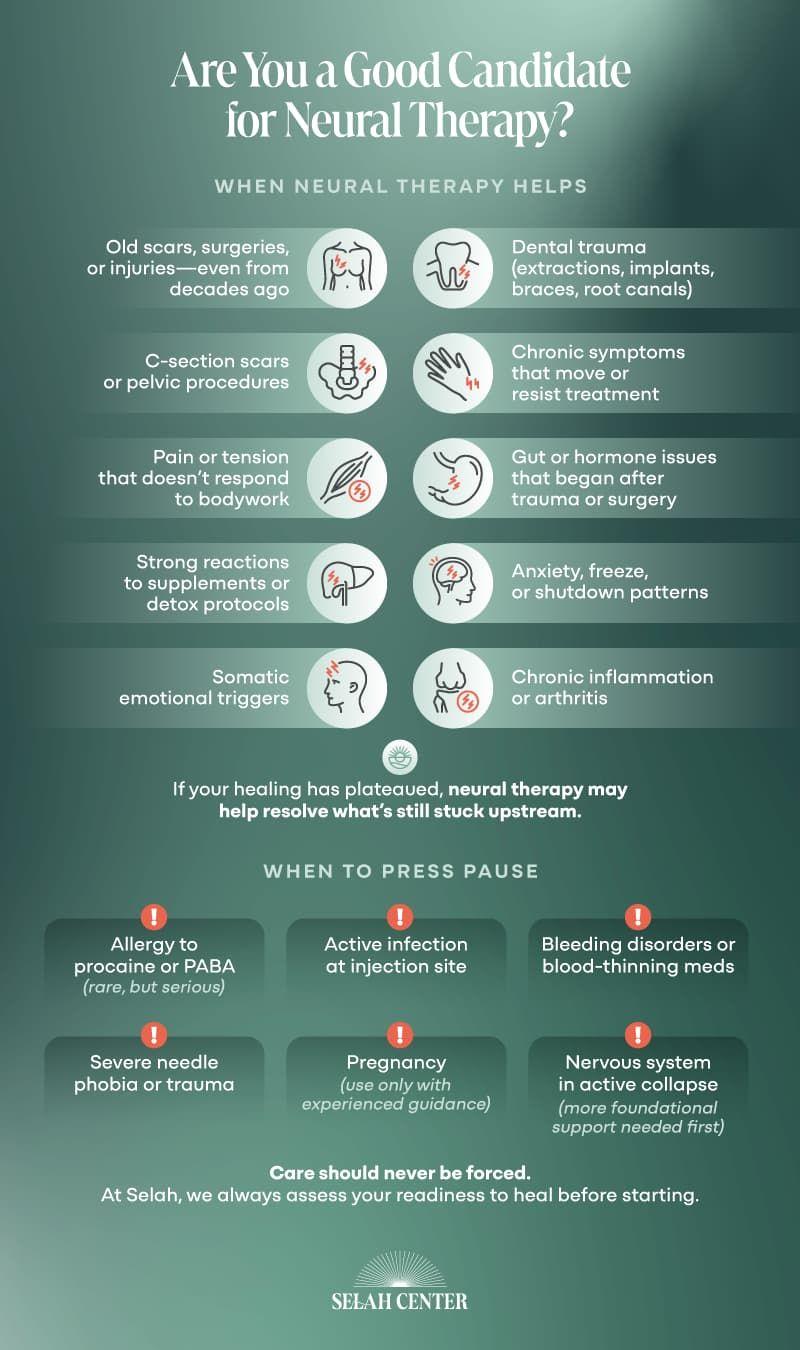
Is Neural Therapy Right for You? Indications & Contraindications
If you’ve been living with chronic symptoms that no one can explain or that no protocol seems to touch, this might be your body’s way of saying: “There’s still interference. You’re treating the downstream effects, but something upstream is still misfiring.”
Neural therapy can be that upstream fix, but it’s not for every situation. Let’s break it down:
Who Benefits Most from Neural Therapy?
You might be a strong candidate if you have:
- Old scars, surgeries, or injuries (even if they “healed” decades ago) (14, 15)
- Dental trauma like root canals, extractions, implants, or even childhood orthodontics
- C-section scars, episiotomies, or other pelvic surgeries (14, 15)
- Unexplained chronic symptoms that flare or move around unpredictably
- Persistent pain or tightness that doesn’t respond to bodywork or therapy (3, 6, 9, 12, 13)
- Hormonal imbalances or gut issues that began after a procedure or trauma (6)
- A strong reaction to supplements or detox protocols (your body may be stuck in survival mode)
- Nervous system dysregulation including anxiety, overwhelm, freeze, or shutdown responses
- Emotional patterns or triggers that feel somatic, not just psychological
- Inflammation or arthritides (3, 4, 5, 6)
If your healing has plateaued or if your intuition says, “There’s still something stuck,” this is often where neural therapy shines.
When Neural Therapy Might Not Be Appropriate
Safety is sacred.
While neural therapy is gentle and well-tolerated for most people, it’s not the right move in every situation.
Here are a few scenarios where we’d pause or proceed with caution:
- Allergy to procaine, its metabolite para-aminobenzoic acid (PABA), or ester anesthetics (6, 10) – This is rare, but it’s a no-go.
- Active infection at the injection site (6) – We don’t want to drive pathogens deeper.
- Uncontrolled bleeding disorders or current anticoagulant use (6) – We may delay or modify treatment.
- Severe needle trauma or phobia – This work can still be done, but we’d take a more integrative approach first.
- Current pregnancy – While there are contexts where neural therapy can be used safely during pregnancy, this requires clinical discretion and an experienced practitioner.
And most importantly: If your nervous system is in active collapse, neural therapy may need to wait until more foundational support is in place.
That’s why at Selah; we always assess your capacity for healing before we dive into interventions.
You’re not your labs or a list of conditions. You’re a whole person, and your biology deserves to be met with care, not force.

The Selah Secret Sauce: Why Layering Neural Therapy Works Better
You can absolutely do neural therapy as a stand-alone therapy.
And sometimes, that’s enough.
But when you layer it—when you support the body’s electrical system, drainage pathways, and emotional processing at the same time—that’s when it gets powerful.
That’s when the stuck stuff finally starts to move. And stay moved.
At The Selah Center, this is where we live.
We don’t just inject scars and send you on your way. We look at your whole terrain:
- Is your nervous system ready to receive this reset?
- Are your detox pathways open enough to process what gets released?
- Is your fascia too bound up to respond to the shift, or is it ready for integration?
- Are we supporting the brain and emotional centers that might get activated in the process?
Because you can’t force your way into healing.
You have to set the conditions and let your body do what it already knows how to do.
What Makes Our Approach Different
At Selah, we combine neural therapy with:
- Clinical-strength nervous system repair – Tools to support vagal tone, resolve freeze states, and bring the body back into regulation.
- Targeted detox and drainage support – So your lymph, liver, and brain pathways are ready to offload the toxins that scars and trauma hold.
- Emotional and energetic reintegration – This includes somatic tools, bio cell salts, and resonance therapies to help your system re-pattern at the deepest level.
This isn’t just about treating tissue.
It’s about treating the story the tissue is holding and inviting your body into a new story.
Scars Tell a Story. Are You Ready to Listen?
Your scars aren’t cosmetic footnotes.
They’re bookmarks in your body’s story; places where the system got interrupted and never fully came back online.
That c-section scar that still pulls.
The childhood surgery that “shouldn’t matter anymore.”
The facelift incision hidden in your hairline, disrupting the flow of lymph and clarity without you ever connecting the dots.
Neural therapy is one of the most elegant tools we have for working with chronic conditions, because it invites healing rather than forcing it.
It creates space for your nervous system to remember safety, for your tissues to return to coherence, and for you to stop surviving and start participating in your life again.
It’s often the piece that makes all the other pieces finally click.
So, if part of you has felt like your body is still stuck in the past, trapped in old trauma, unreleased pain, or just some intangible sense that things never quite worked right again after that one event…
This is your invitation to listen.
And if you’re ready to take the next step, we’d be honored to walk with you.
FAQs
1. What exactly is neural therapy?
Neural therapy is a bioregulatory treatment using gentle injections (usually with procaine) to reset the body’s nervous system signaling. It helps restore balance where trauma, scars, or injury have created interference fields.
2. Does neural therapy hurt?
Most clients report little to no discomfort and many say it’s gentler than a B12 shot. Some feel a tiny pinch, and others don’t feel the injection at all.
3. What types of issues can it help with?
Great question! Soooo many issues can be helped with neural therapy, including: Trigeminal neuralgia (7), chronic pain syndromes (3, 6, 9, 12, 13), gastrointestinal disorders (6), inflammatory diseases (3, 6), cardiovascular syndromes (6), fibromyalgia (1, 6), depression (6), fatigue (6), headaches and migraines (6), MS (11), plantar fasciitis (5), low back pain (8) and more!
4. Is procaine safe?
Yes. Procaine is a short-acting ester anesthetic that breaks down quickly in the bloodstream. It’s metabolized easily and has a low risk of side effects when used properly.
5. Can neural therapy help if I don’t have visible scars?
Yes. Everyone has at least one scar (the umbilical) and interference fields can also form from dental work, emotional trauma, piercings, or even internal adhesions.
6. What does it feel like after a session?
Clients often report feeling lighter, clearer, more grounded, or like their system finally exhaled. Some notice immediate symptom relief; others experience gradual shifts over several days.
7. What’s an interference field, exactly?
An interference field is a spot in the body where normal nerve signaling has been disrupted, usually due to injury, surgery, or trauma. It can send confusing signals to other areas and block healing until it’s cleared.
8. Can neural therapy help with emotional trauma?
Yes, and this happens more often than you’d think. Scar tissue can hold emotional memory. Releasing the interference field may bring unexpected emotional release. And we’re here to support that process.
9. Are there risks or side effects?
Neural therapy is generally very safe. Rare side effects may include temporary soreness or fatigue. It’s not recommended for people with procaine allergies, active infections at the injection site, or certain bleeding disorders.
10. Can I combine neural therapy with other treatments?
Absolutely. In fact, we encourage it. At Selah, we layer neural therapy with nervous system repair, detox support, and emotional integration tools to create deeper, more lasting results.
References (15)
- Balevi Batur, E., & Atan, T. (2020, December 21). Neural therapy for fibromyalgia: Myth or improving quality of life? - PubMed. International Journal of Clinical Practice; Wiley.
- Choi, K.-E., Grünert, J., Werner, M., Cramer, H., Anheyer, D., Dobos, G., & Saha, F. J. (2024). Low Inter-Rater Reliability and Reproducibility of Neck Reflex/"Adler-Langer" Points in Neural Therapy Diagnostics but Increased Pressure Pain Threshold after Therapy: Results of a Randomized Controlled Observer-Blind Trial - PubMed. Complementary Medicine Research; S. Karger AG.
- Egli, S., Pfister, M., Ludin, S. M., Puente de la Vega, K., Busato, A., & Fischer, L. (2015). Long-term results of therapeutic local anesthesia (neural therapy) in 280 referred refractory chronic pain patients. BMC Complementary and Alternative Medicine, 15(1).
- Evcik, D. (2023). Comparison Of Kinesiotaping, Trigger Point Injection, And Neural Therapy In The Treatment Of Acute Myofascial Pain Syndrome: A Randomized Controlled Study. Ağrı - The Journal of The Turkish Society of Algology.
- Fleckenstein, J., König, M., & Banzer, W. (2018, August 21). Neural therapy of an athlete’s chronic plantar fasciitis: a case report and review of the literature - PubMed. Journal of Medical Case Reports; Springer Science and Business Media LLC.
- Haller, H., Saha, F. J., Ebner, B., Kowoll, A., Anheyer, D., Dobos, G., Berger, B., & Choi, K.-E. (2018). Emotional release and physical symptom improvement: a qualitative analysis of self-reported outcomes and mechanisms in patients treated with neural therapy. BMC Complementary and Alternative Medicine, 18(1).
- Lopes, C. A., & Fischer, L. (2023). A case of severe trigeminal neuralgia: recovery by means of stellate ganglion block with procaine. Discussion of possible mechanisms of action. Journal of International Medical Research, 51(4), 1–8.
- Nazlıkul, H., Ural, F. G., Öztürk, G. T., & Öztürk, A. D. T. (2018, November 28). Evaluation of neural therapy effect in patients with piriformis syndrome - PubMed. Journal of Back and Musculoskeletal Rehabilitation; SAGE Publications.
- Saha, F. J., Komhard, V., & Langhorst, J. (2014). [Successful endoscopic neural therapy of a patient with chronic pain syndrome after rectum gunshot injury] - PubMed. Complementary Medicine Research; S. Karger AG.
- Steinman, J., & Tan, K. T. (2025). Local anaesthetics in interventional radiology: a primer for radiologists on applications and management of complications. Clinical Radiology, 85, 106917.
- Tamam, Y., Özdemir, H. H., Gedik, A., Tamam, C., & Nazlıkul, H. (2017, January 13). Efficacy of peripheral lidocaine application (neural therapy) in the treatment of neurogenic detrusor overactivity in multiple sclerosis patients - PubMed. Neurourology and Urodynamics; Wiley.
- Valencia Moya, A., Navarro Suay, R., Fernández González, J. A., Gutiérrez Ortega, C., Panadero Useros, T., & Mestre Moreiro, C. (2020, January). Selective local anesthesia versus corticosteroid infiltration on low back pain: a randomized clinical trial - PubMed. Revista Española de Anestesiología y Reanimación; Elsevier BV.
- Weinschenk, S., Hollmann, M. W., Göllner, R., Picardi, S., Strowitzki, T., Diehl, L., Hotz, L., & Meuser, T. (2016). Injections of Local Anesthetics into the Pharyngeal Region Reduce Trapezius Muscle Tenderness - PubMed. Complementary Medicine Research; S. Karger AG.
- The Bioregulatory Medicine Institute The Science of Self-Healing Podcast The Bioregulatory Medicine Institute The Science of Self-Healing Podcast. Can Scars Really Block Your Healing? Accessed August 2, 2025.
- Neural Therapy. Accessed August 2, 2025.
This article is for general education and is not a substitute for personal medical advice.